GeoMentors Blog - Page 6

cancel
Showing results for 
Show  only  | Search instead for 
Did you mean: 

Latest Activity

(125 Posts)
JoleneKeen1
Frequent Contributor

GeoMentor Case Study:

Nathan Onwonga

City/State of School, School District, or Group: Kenya, Kisii district.

Grade level of students you or your educator collaborator work/worked with: Form1- Form4

Subject/topic of class/group you assisted your collaborator with: Land forming processes.

Approximately how many students were engaged in GIS activities through this collaboration: 78 students.

How did you connect with your collaborator? I reached out to local school.

Describe your collaboration process. Regularly, daily.

Describe the tasks you assisted your collaborator with. Project vision, and career-related information. I helped the collaborator on how to expect arcgis online work, I also helped learners to choose on their careers especially in geography and Gis.

What available resources, if any, did you use or help your collaborator use to implement GIS in K-12 education? Esri eastern Africa website.

Did you develop any new educational material or GIS activities through your collaboration? Yes, how Gis can help in conservation of water resources, to help communities and schools get enough and clean water through detection of pit latrines and sewage lines to avoid them.

What did you gain from the experience? What do you think your educator collaborator and/or the students gained? New ideas geography can offer that can be spatially integrated.

Any additional comments about your experience? This work requires patience since no payment is offered at some point it discourages but with heart we proceeds.

Check out more case studies here!

If you're interested in submitting your GeoMentor experience for a case study, we would appreciate you doing so through this survey. The collected information will only be accessible to and used by AAG and Esri program staff and will not be further distributed or posted online unless you indicate your permission to do so.

Questions? Email geomentors@aag.org.

more
0 0 290
JoleneKeen1
Frequent Contributor

GeoMentor Case Study:

Nettie Ginocchetti


City/State of School, School District, or Group: Plains, Pennsylvania; Wilkes-Barre Area School District; SHINE After School Program of Luzerne County at Wilkes University

Grade level of students you or your educator collaborator work/worked with: K-8

Subject/topic of class/group you assisted your collaborator with: Topics of discussions included ArcGIS Online, GeoInquiries, Web Maps, Story Maps, Entertain Maps, Snap2Map, the Living Atlas and the Science Channel: What on Earth

Approximately how many students were engaged in GIS activities through this collaboration: 60 students

How did you connect with your collaborator? We connected through a PennDOT Long Range Transportation meeting I was attending where an ambassador of PA State Senator John Yudichak was present. Senator Yudichak is a founder of the SHINE After School Program of Luzerne County. When I spoke about our GeoMentoring efforts in NEPA, Mark Grochocki, District Director suggested I contact the Executive Director of the SHINE Program to talk about GeoMentoring within the SHINE Program.

Describe your collaboration process. We communicate on a weekly basis to discuss our volunteer efforts through email or texting. Establishing a weekly game plan may take a half hour of our time throughout the week.

Describe the tasks you assisted your collaborator with. As Geomentors for the SHINE After School Program we lead the discussion in educating the students and teachers. Topics range from currents events by means of Esri Story Maps to adding map layers to a web map and analyzing the different layers such as Fast Food Chains, to watching videos from the Science Channel What on Earth and discussing the different uses of GIS that we saw in the video. The teachers are part of the audience and are additionally learning about the powers of GIS through the SHINE After School Program.

What available resources, if any, did you use or help your collaborator use to implement GIS in K-12 education? Through our educating efforts we use:

ArcGIS Story Maps

Snap2Map

Esri current event maps such as: http://storymaps.esri.com/stories/thanksgiving

The Science Channel: What on Earth

Entertain Maps

Did you develop any new educational material or GIS activities through your collaboration?

SHINE GIS Gallery

SHINE Locations Web App

2016-2017 SHINE Story Map that documents our GeoMentoring Efforts at the Wilkes-Barre Career and Technical Center

SHINE Lights On After School App

Various Snap2Map Story Maps
http://arcg.is/2eYnfqP
http://arcg.is/2eYr3by
http://arcg.is/2nW0AiE
http://arcg.is/2d71w03

Presently working on a 2017-2018 Story Map highlighting our progress throughout this school year.

What did you gain from the experience? What do you think your educator collaborator and/or the students gained? I have gained a tremendous amount of admiration for the education system, students and teachers. Stemming from a degree in GIS primarily in the Transportation Industry while being introduced to the Education industry has been a learning experience. The amount of collaboration and positive engagements assignments is crucial to learning and I have a gained a deeper respect for the amount of preparedness that goes into teaching and and entertaining young minds.

I feel the students and educators gain a sense of a whole new world and industry that exists out there, that they may not have otherwise discovered. I would hope that our efforts of raising geoawareness introduces these young minds k-8 to the possibilities of a future career in the Geotechnologies field. 

If your GeoMentoring engagement activities were documented through a classroom blog, school website, group’s social media post, newspaper or other media, please provide the websites of those posts. On GIS Day 2016 we celebrated with 60 students from the SHINE Program at the Wilkes-Barre Area Career and Technical Center located in Plains, PA with a drone demonstration by an undergrad student from King's College.

SHINE GIS Gallery

Gallery of our 2016-2017 SHINE GeoInspirations

Any additional comments about your experience? I would like to thank Esri and the American Association of Geographers for providing this opportunity by inspiring me to make an impact on the future of learning and the endless career opportunities that await these young minds in the field of Geotechnologies. I am forever grateful for the experiences I have encountered in my first year GeoMentoring with the SHINE After School Program.


Check out more case studies here!

 If you're interested in submitting your GeoMentor experience for a case study, we would appreciate you doing so through this survey. The collected information will only be accessible to and used by AAG and Esri program staff and will not be further distributed or posted online unless you indicate your permission to do so.

more
4 0 645
JoleneKeen1
Frequent Contributor

GeoMentor Case Study: 

Deborah Huber, GISP; Katharine Chaney, GISP;

Brian Dresen, LS

City/State of School, School District, or Group: Chesapeake, VA

Grade level of students you or your educator collaborator work/worked with : High School Juniors and Seniors

Subject/topic of class/group you assisted your collaborator with: GIS Immersion

Approximately how many students were engaged in GIS activities through this collaboration: 11 students from Grassfield

How did you connect with your collaborator? The initial partnership with Grassfield STEM Academy was introduced through an employee whose son attended the school. We have continued to partner with the Grassfield STEM academy each summer.

Describe your collaboration process. There is an initial information night for the students where they can meet with representatives from different firms/companies. The students are then allowed to sign up for the company they are interested in. I meet with the Department Heads to see how much time they can commit to mentoring the students each summer. Then, I let Amie Beahm/Grassfield know how many students we can accept each summer.

Describe the tasks you assisted your collaborator with.
Clark Nexsen is a Multi-Disciplinary firm – Architecture, Civil Engineering, GIS, Transportation, Bridges, Wireless and Interiors. Each summer, Grassfield high school students enrolled in the STEM program are invited to our corporate office for a week of immersion. The STEM students meet for several hours with each department, to learn about how professionals in these fields do work their day-to-day projects. This summer, we had three groups come thru the program.

The GIS Department had the students for a three-hour span. We divided our GIS information into five sections:

1. Basic Overview - What is GIS?, How many industries GIS supports, How GIS can be used to analyze data to solve problems, and How we use GIS at Clark Nexsen. Also, the components of GIS, a BASIC explanation of Map Projections, and images of GPS equipment. We then provide them with links to local colleges with Geospatial classes and programs with links to useful geospatial websites.

2. Build a Map: Finding and importing data, adding collected GPS points, adding building footprints, adding base maps, changing Symbology, and adding labels, etc.

3. GIS related Apps that are fun to use. We show how we use the what3words free app during our field work - mostly for fun and adventure/social activities in our off hours, but also to assist us in foreign countries where there is a language barrier. We demonstrate using it for marking parking garages in New York City, locating a co-worker on a beach among hundreds of people, and navigating Japanese train stations.

4. Equipment Overview: Our surveyor demonstrates some of the equipment we use in the field – Leica Disto Laser Range finders for measuring building footprints (we let the students measure the room), the Trimble GPS units (more about this later) and the ToughPads with DraftSite (a lite CAD program) and ArcGIS Desktop loaded.

5. Scavenger Hunt: We took the students to a park across the street. Half were given what3words locations to navigate and the other half use Trimble Geo7X units with external antennas (with guidance). They then located the spot they are assigned – when they found it, they received a packet of Clark Nexsen swag. It is a good way to demonstrate the precision of professional GPS equipment versus a smartphone app.

Our overarching goals were to engage the students, open their awareness to GIS, and show how they are already interacting with GIS without even realizing it (navigational apps). Some of the students were unsure of the exact degree they wish to pursue, so we showed how a course or two in GIS could support most of the industries included in the STEM program. Once in college, we offer them to return to us for their internships during the summer months. Once graduated from college, some of our interns have returned to start their careers with us.

What available resources, if any, did you use or help your collaborator use to implement GIS in K-12 education? None that I am aware of, but we could provide the weblink to the FREE K-12 program through ESRI. We DID provide the ESRI links to the students in the follow-up email we sent after the event. http://www.esri.com/industries/education/schools#

Did you develop any new educational material or GIS activities through your collaboration? Yes, a Geo-Locational Scavenger Hunt. See details in #5 above.

What did you gain from the experience? What do you think your educator collaborator and/or the students gained? Our GIS department gained a new perspective of how little the high school demographic is aware of GIS as a stand-alone technology field of study, how the Science of Where is at the forefront of so many industries, and how GIS plays a role in their daily lives.

We are hoping they gained a general understanding of GIS and how it can walk lock-step with the STEM industries they are interested in pursuing. Once we met the kids, we opened the option to provide their email address so we could provide follow-up information on the colleges offering GIS programs and a sheet of helpful weblinks to Geospatial websites. 

Check out more case studies here!

 If you're interested in submitting your GeoMentor experience for a case study, we would appreciate you doing so through this survey. The collected information will only be accessible to and used by AAG and Esri program staff and will not be further distributed or posted online unless you indicate your permission to do so.

more
1 0 570
JoleneKeen1
Frequent Contributor

November 2017 GeoMentor Spotlight:

Jessica Griffin, GIS Specialist at ExteNet Systems

What was your favorite class in K-12? Art

How did you first learn about and/or use GIS? While earning my Masters of Science in Archaeology, a professor mentioned that GIS software was changing the field of archaeology. I wanted to know more so I took GIS classes and completed a GIS certificate.

Name one thing you love about GIS and/or geography (I know, just one!): GIS software has so many applications in a myriad of fields. You can use it to study climate, biology, humans (past, present and future) and use the tools to answer questions and solve problems. The possibilities are endless.

Why did you want to volunteer as a GeoMentor? I got my Bachelors in Social Science education and earned a teaching certificate. Though I didn’t become a teacher, I really enjoy helping kids learn and broaden their horizons. And I think it’s important to show girls a positive role model of women working in STEM fields.

What kind of GeoMentor volunteer opportunity and experience are you looking for? I’d like to engage with teachers and kids in the classroom and talk with them about how to use the GIS tools, and encourage them to use the software to do their own research and answer their own questions about society and the world around them.

If someone asked you why they should learn about GIS and/or geography, how would you respond in one sentence? Geography is a lens through which you can view any issue, and it has a huge impact on how our world is organized and how we live our lives.

Email address: GriffinJessicaD@gmail.com

Websites
https://www.linkedin.com/in/jessica-griffin-1a810446/
https://oldmainartifacts.wordpress.com/ ( a blog about my archaeological research)

Read about our latest featured GeoMentor here!
If you are interested in being featured, visit here for more information.

Questions? Email geomentors@aag.org.

more
0 0 559
CandiceLuebbering
Frequent Contributor

Consider participating in a global community event focused on open mapping that is taking place soon - OpenStreetMap's (OSM) Geography Awareness Week activities (OSMGeoWeek). This is an annual coordinated community effort driven by the OSM community to encourage teachers, students, community groups, governments, private sector organizations, and map-lovers around the world to host “mapathons” and to create much-needed map data for humanitarian and development efforts. OSM works closely with MapGive, a State Department public initiative focused on open mapping that is amplifying outreach and organization for the event.


Last year, in partnership with HOTMissingMapsMapGiveYouthMappersPEPFAR, and many more, there were 140 events in 42 countries - this year the goal is over #200mapathons! If you want to register an event or attend an event taking place near you, visit osmgeoweek.org for more details. Events can be of any size, and registration is easy - to register an event, fill out this FORM and your event will be registered on both the OSMGeoWeek and Missing Maps event pages. Regional support is available in some locations, so make sure you register your event. The project section of the site will include mapping projects where key partners have identified serious map data needs that can be filled through crowdsourced mapping.


Help spread the word by using #OSMGeoWeek on social media and following @MapGive. Contact mapgive@state.gov if you have any additional questions.

more
1 0 517
CandiceLuebbering
Frequent Contributor

Are you attending the 2018 AAG Annual Meeting in New Orleans?  We are looking for GeoMentors to share their volunteer engagement stories in a panel session, “GeoMentors: A Showcase of Volunteer Efforts in K-12 Geography Outreach”.  The goal of the session is to provide a variety of example activities that our GeoMentors have done to spark conversation about approaches to geography education outreach and public engagement (one of the meeting’s major themes!).  We’re also planning to allow time for current GeoMentors and those new to or interested in the program to meet, interact, and learn from each other through a Q&A portion and further informal conversations after the presentations.  We welcome ALL GeoMentor presenters at all levels who have experiences to share (undergrad and grad students, we’d love to have you!).

Panelists will each give a brief presentation (10 minutes max; 10 presentation slides max) providing a quick overview of the context (location, audience, and collaborators), content (topic, technology, activity), and process (from connecting with schools to developing/implementing activities) of their GeoMentor experience as well as any lessons learned. Think of this as a fun, informational show and tell of your volunteer experience to the very welcoming and supportive environment of our GeoMentor and geography community.  After the panelist presentations, we’ll have a Q&A session, encouraging any other attending GeoMentors to share their experience, and also allow time for mingling among all attendees to encourage further conversations about the program and geography education efforts.

If you are interested in being a panelist, please contact  Jonathan Wessell at jonathan.wessell@gmail.com with your meeting pin number so we can add you to our session.  We’re excited to have you join us!

more
0 0 439
JoleneKeen1
Frequent Contributor

The October GeoMentors Newsletter is now available! Prepare for GIS Day and Geography Awareness Week, meet our both of our spotlight GMs, take a shot at the monthly mentor challenge, look at some new featured resources and more!

more
1 0 277
JoleneKeen1
Frequent Contributor

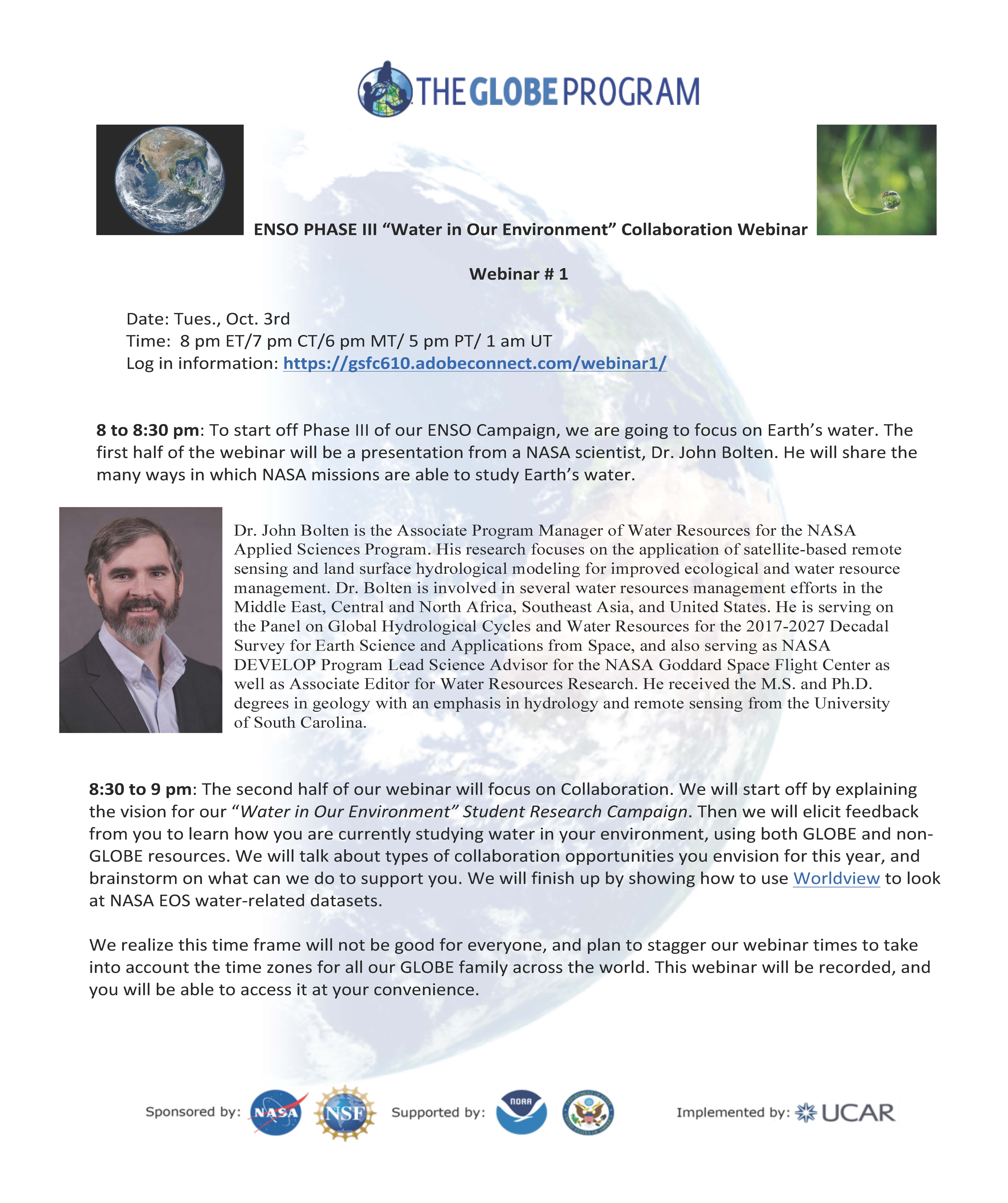
https://smap.jpl.nasa.gov/system/internal_resources/details/original/252_globe_program.jpg

Date: Tues., Oct. 24th

Time:  5 pm ET/4 pm CT/3 pm MT/ 2 pm PT/ 11 pm UT
Log in information: https://gsfc610.adobeconnect.com/webinar1/

NASA Scientist John Bolten

5 to 5:30 pm: To start off Phase III of our ENSO Campaign, we are going to focus on Earth’s water. The first half of the webinar will be a presentation from a NASA scientist, Dr. John Bolten. He will share the many ways in which NASA missions are able to study Earth’s water.
Dr. John Bolten is the Associate Program Manager of Water Resources for the NASA Applied Sciences Program. His research focuses on the application of satellite-based remote sensing and land surface hydrological modeling for improved ecological and water resource management. Dr. Bolten is involved in several water resources management efforts in the Middle East, Central and North Africa, Southeast Asia, and United States. He is serving on the Panel on Global Hydrological Cycles and Water Resources for the 2017-2027 Decadal Survey for Earth Science and Applications from Space, and also serving as NASA DEVELOP Program Lead Science Advisor for the NASA Goddard Space Flight Center as well as Associate Editor for Water Resources Research. He received the M.S. and Ph.D. degrees in geology with an emphasis in hydrology and remote sensing from the University of South Carolina

5:30 to 6 pm: The second half of our webinar will focus on Collaboration.  We will share NASA Wavelength list of resources that teachers can use to teach students background behind this question, have a few GLOBE teachers/students in the U.S. share some “Best Practices” when using hydrology protocols and describe what they’ve learned about water quality in their region; discuss ideas for potential collaborations related to water quality, and discuss resources/support we can offer to enhance their collaboration.
 

We will focus on how to use NASA Wavelength as an instructional resource.

Upcoming events

We realize this time frame will not be good for everyone, and plan to stagger our webinar times to take into account the time zones for all our GLOBE family across the world. This webinar will be recorded, and you will be able to access it at your convenience.  Our next webinar, on Nov. 14th, will take place during a time that is convenient for those in Europe.
 

more
0 0 263
JoleneKeen1
Frequent Contributor

Good day,

The 2018 GIS for Transportation (GIS-T) Symposium will be held from March 19-22 in Little Rock, Arkansas, and once again will feature a Student Presentation Contest.  Undergraduate and graduate GIS students with an interest in transportation applications of GIS-T are encouraged to submit their research in the form of a paper to the GIS-T Symposium's Student Paper review panel.  The contest is designed to encourage university students to develop solutions to current GIS-T issues.  Contestants' submissions will be judged on their ability to develop and document useful, original research based on GIS-T issues and on their ability to present their results in a complete, clear, and well-referenced paper. The winner will receive $100, travel expenses, 4 nights' lodging, and complementary registration to the 2018 GIS-T Symposium to present their paper.

We encourage you to circulate this e-mail to students to may be interested in submitting a paper.  The submission deadline is December 1st, 2017.  Selection of the winner will be made by mid-January, 2018.  Full details on the contest will be provided shortly on the GIS-T Symposium website.  Student presentation submissions or questions should be directed to: Mr. Don Kiel or Dr. Eunsu Lee.
 
Thanks for your consideration!

Don Kiel
SEDA Council of Governments

more
0 0 461
JoleneKeen1
Frequent Contributor

TONIGHT at 8pm ET! Join the ENSO PHASE III “Water in Our Environment” Collaboration Webinar to learn ways to teach students about water and the environment! You do not have to be a member of the GLOBE program to attend.

It's open to everyone!

more
0 0 232
27 Subscribers