Integrating Locate Data into ArcGIS
Maximizing Safety, Efficiency, and Spatial Intelligence for Utility Management
Introduction
The safe management of underground utilities is a cornerstone of modern infrastructure planning. As urban environments become denser and utility networks more intricate, the need for reliable information concerning subsurface assets has never been greater. In North America, the "811" service (Locates)—commonly known as "Call Before You Dig"—has become a critical resource for preventing accidental utility strikes during excavation. Integrating Locate data into Geographic Information Systems (GIS) represents an innovative approach to spatial analysis and utility management, offering nuanced insights and operational benefits for municipalities, utility companies, and contractors alike.
What is Locate Data?
Locate data refers to information collected by the "Call Before You Dig 811" service, mandated by law in the United States and Canada. Whenever an individual or organization plans to excavate, they are required to notify the Locate (811) system, which then alerts utility owners in the area. Utility companies respond by marking the location of buried infrastructure—such as gas pipelines, water mains, telecommunications cables, and electrical lines—either on the ground or via digital records.
These tickets typically include requests for details, such as location, type of work being performed, date/time of locate and marking status as to if it’s dispatched, pending, working or completed. The coordinates of the Locate or where the dig is taking place is another important entity of the ticket as well as utility ownership information including the type of utility such as gas, electric, water, etc. and responses or notifications that may be required. Tickets are usually in the form of a printout, email and may contain a sketch or map of where the locate it taking place.
Why Integrate Locate Data into ArcGIS?
GIS technology excels in visualizing, analyzing, and managing spatial data. When Locate data is incorporated into the ArcGIS platform, organizations gain powerful capabilities to prevent utility strikes by mapping the location of underground assets. This allows excavators to plan around hazards and avoid accidental damage. Overlaying Locate data with other spatial layers—such as property boundaries, topography, and zoning—allows for smarter site selection and construction planning. Demonstrating that Locate protocols have been followed and incidents tracked spatially can help satisfy legal requirements and reduce liability.
In the event of a utility failure or leak, GIS-integrated Locate data enables rapid identification of affected assets and efficient deployment of repair crews. Utility owners can maintain more accurate and current records of their underground assets by incorporating Locate data, reducing maintenance costs and improving long-term planning.
By analyzing the Locate data compared to legacy GIS data, decisions can be made to increase the accuracy of GIS by using this valuable data. Utilities use this data daily; most don’t do anything with the data once collected and marked (spray painted).
The Industry Problem
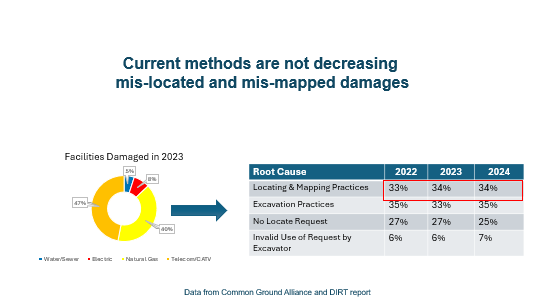
Underground utilities are hit hundreds of times each day in the U. S. with damage costing the US economy approximately $30 billion annually (Source CGA). This number has not decreased in the last 3 years. Is the reason because of legacy mapping or is it the Locate itself? Below are some challenges that are faced by utilities.
Utility Industry Challenges:
- Difficult to measure Quality of the Locate location
- Lack of spatial accuracy with utility map data
Technology Challenges:
- Locate hardware lack’s ability to capture location
- No direct communication with the ArcGIS system
People Challenges:
- Cannot degrade field locator productivity
- Needs to be simple to use
New Capabilities Presents New Opportunities
What can Esri do to help our users overcome these obstacles? Over the past year we have made strides with hardware vendors to allow Locate Data to go directly into ArcGIS. Utility Locate hardware providers have integrated GNSS into their devices. With RTK enablement, capabilities with sub-centimeter accuracy and ease of connectivity, can now be realized.
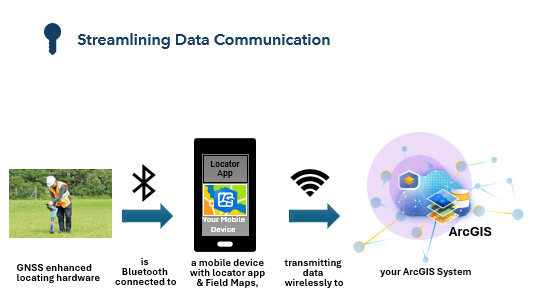
Streamlined Data now new capabilities can be explored. This data can also be used for relocating.
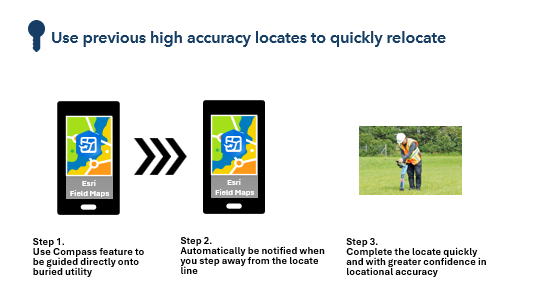
With this new capability, data can be captured as the Locate takes place that records information such as:
- Locate ID or Workorder Number to track the Locate
- Who performed the Locate
- When the Locate started and finished (time and date)
- Metadata documenting spatial accuracy
- Metadata documenting Locate metrics
- Easily attach photos or video to show locate record.
Using this data, opportunities to update legacy GIS data with more accurate utility maps for your organization will exist.
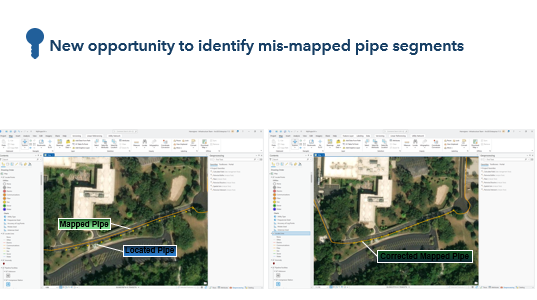
As part of the locate enhancement, we will be providing a new source for map corrections. A new schema will be available.
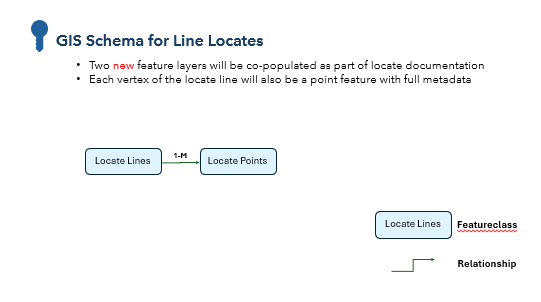
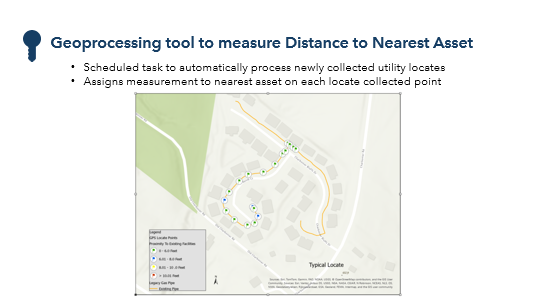
This will enable you to store your locate data in a common format and schema as a new source for map corrections. In addition, there will be a new Geoprocessing Tool to measure Distance to Nearest Asset. As an example, this tool will allow you to categorize distances such as 0-6’, 6.01’ – 8’, 8.01 – 10’ and then greater 10’ from existing legacy data. These are user defined categories to help with prioritization.
Sharing and Collaboration
The ArcGIS Platform supports sharing interactive maps and data with stakeholders, including contractors, utility owners, and regulatory agencies. Cloud-based systems enable real-time updates and mobile access. This data can be accessed for current or historical locate data that can be used both inside and outside of the office.
Mapped as layers over aerial imagery, base maps, existing facilities, ROW and parcel data can be created. Analyzed data for density, proximity and spatial relationships such as identification of areas with frequent excavation requests or areas where utility strikes occur, can be summarized in ArcGIS by using reports and dashboards. Locate maps can be created to support project managers, field crews and share throughout the organization.
Applications: Real-World Use Cases
In addition to what was previously discussed in this blog, Locate data in ArcGIS opens the door to a variety of practical applications. Since this data can be shared with your organization, opportunities open and can be created just by the presence of this data.
Urban Planning and Development
City planners use GIS-enabled Locate data to identify safe corridors for new construction, avoid utility congestion, and prioritize upgrades. By overlaying utility data with zoning and environmental layers, planners make informed decisions that minimize risk and disruption.
Construction and Excavation Management
Excavators can access GIS maps showing marked utilities and recent ticket activity, reducing the chances of costly mistakes. Project managers schedule work based on marking completion and utility owner responses, streamlining timelines.
Disaster Preparedness and Emergency Response
During natural disasters—such as floods, earthquakes, or hurricanes—first responders and utilities rely on GIS-integrated Locate data to locate critical infrastructure and coordinate repairs. Spatial analysis helps prioritize resources where they are most needed.
Utility Asset Mapping and Maintenance
Utility companies benefit by maintaining up-to-date GIS inventories of underground assets. This supports proactive maintenance, replacement scheduling, and risk assessments. Using Locate Data, existing asset mapping can be compared to data being collected in the field for more accurate mapping.
Regulatory Compliance and Reporting
GIS records of locate tickets and marking activities provide defensible evidence of regulatory compliance. Automated reporting capabilities assist with audits and legal reviews.
Conclusion
The collaboration of Locate data and GIS marks a transformative step in utility management, excavation safety, and infrastructure planning. By leveraging spatial intelligence, stakeholders can mitigate risks, enhance operational efficiency, and uphold regulatory standards. As technology evolves and data sharing improves, the strategic integration of Locate data into GIS will continue to shape safer, smarter communities for generations to come.
PLEASE NOTE: The postings on this site are my own and don’t necessarily represent Esri’s position, strategies, or opinions.