If you missed last week's Agriculture SIG at Esri’s 2025 User Conference, here’s a brief summary: The session, led by Mark Dann, Dr. Elvis Takow, and myself from Esri, featured presentations on ArcGIS as an Artificial Intelligence (AI) Platform and how to refocus AI on Agriculture Intelligence. Afterwards, a panel discussion included representatives from AC Foods, Land O’Lakes, and Texas A&M.
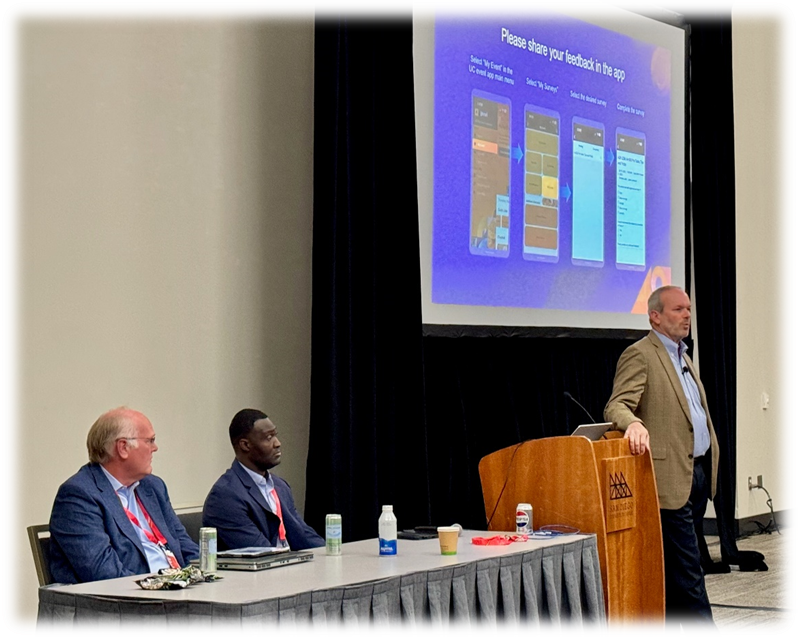
The ArcGIS AI Platform by Dr. Takow
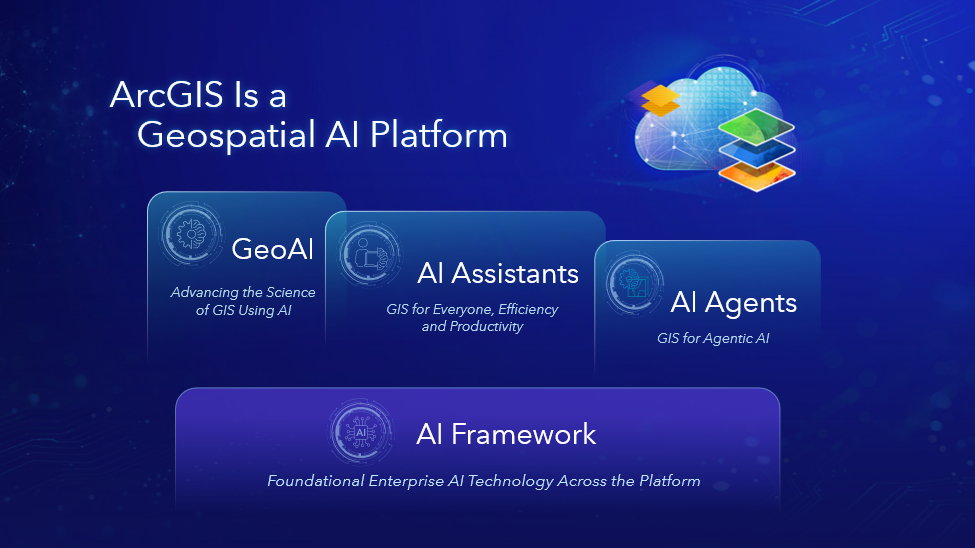
As a summary of many sessions at the conference, Dr. Takow presented ArcGIS as a geospatial AI platform that uses artificial intelligence to increase productivity, support decision-making, and drive innovation. Its three main components are:
- GeoAI analysis for automated data creation, extraction, and analysis,
- AI assistants with conversational interfaces to streamline workflows,
- An underlying AI framework supporting both features.
To meet this technological vision, Esri is updating its AI features to include Assistants, Skills, Agents, and pre-trained models. The platform is designed to remain extensible and customizable for different industries and needs. The framework also allows for the integration of AI, deep learning, and large language models, while also supporting developers in creating custom AI services and integrations.
The challenge for the Agriculture GIS community will be to carefully introduce a broad range of capabilities into an industry that must succeed given the constant pressures of producing a food supply for a growing population. For that, we need Agriculture Intelligence, as discussed in the next section.
Agriculture Intelligence by Nick Short
While we have heard that ArcGIS is a key Geospatial AI Platform for innovation, how can that help agriculture? This presentation briefly explained how to approach AI appropriately and in a relevant way, why now is the right time, how we can avoid past mistakes, and how Esri's experience and longevity benefits the agriculture industry.

In considering the integration of artificial intelligence (AI) within the agricultural sector, it is pertinent to pose the question: “What defines AI for Agriculture?” This inquiry serves as an invitation to ongoing dialogue about the evolving role of AI in agricultural practice, both now and in the years ahead.
A central concept must remain at the forefront of this discussion: trust.
For the agricultural industry, trust is paramount, particularly in the context of emerging technologies such as AI. Producers and stakeholders often greet technological innovation with skepticism, expressing concerns regarding data privacy, security, and the complexity or usability of new systems. Moreover, the industry’s persistent economic pressures amplify the need for reliability and assurance before widespread adoption can occur.
The core challenge, therefore, is to determine how the agriculture sector will navigate the adoption of AI technologies in a manner that both fosters and maintains trust within the community.
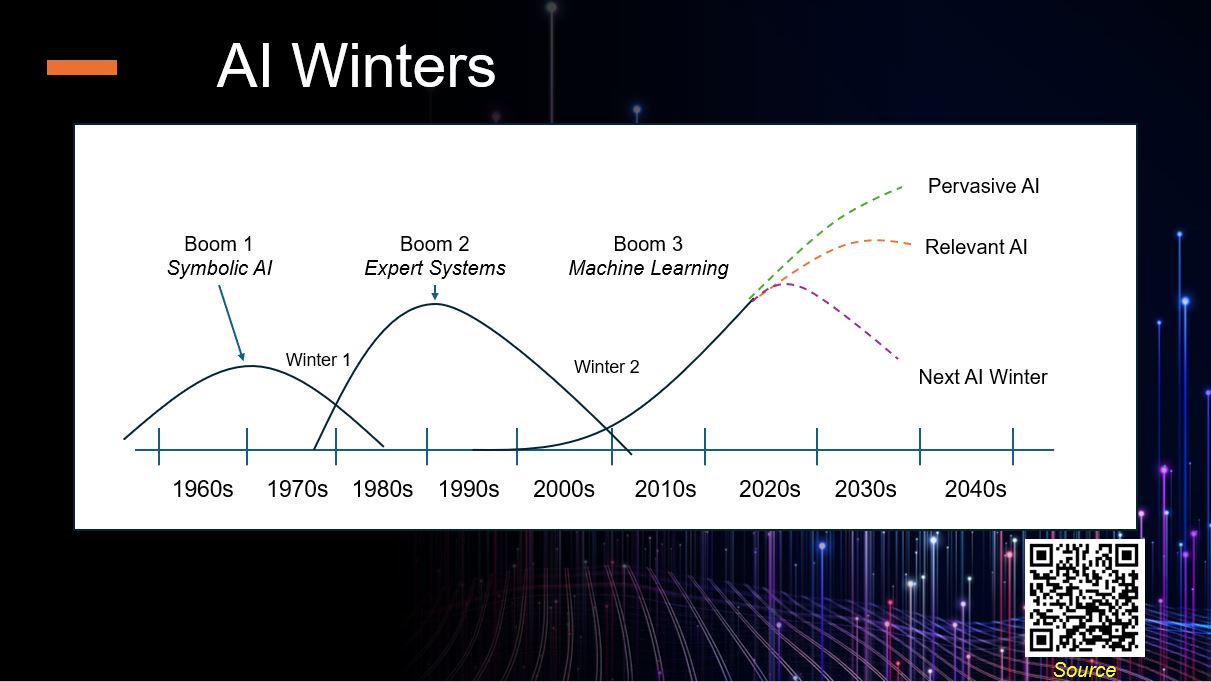
Examining the history of AI offers insights into its patterns of trust and adoption within industry.
Unfortunately, AI’s development is marked by alternating periods of growth and decline—often referred to as “AI Winters”—where expectations were not met, leading to phases of disillusionment.
In the 1980s, AI enjoyed a surge of popularity, with major government organizations investing in artificial intelligence to capture human knowledge in the form of expert systems. AI was seen as a promising tool for tackling large-scale challenges, including climate change research and precision agriculture. This period was marked by optimism and high expectations regarding AI’s potential to revolutionize data analysis and decision-making, leading to significant research and practical applications in key industries.
By the late 1990s, unfortunately, many organizations discontinued their AI program, as the industry pivoted to the web and away from the dream of AI. During that period, the term "AI" was sometimes avoided due to previous unmet promises, where it was often called Almost Implemented. From these experiences, several lessons emerged from that era:
1. Scalability Limitations
A significant challenge was managing and storing very large datasets, specifically with respect to the variety and velocity of data. Database management systems at the time did not adequately address these needs, highlighting the importance of robust and adaptable data management infrastructures—particularly relevant in sectors like agriculture.
2.Too Much Dependence on Open Source Tools
Due to a limited number of commercial solutions, there was heavy reliance on internally developed tools and open-source software, which created maintenance and security concerns after personnel changes.
3. The Importance of High-Quality Training Data
Developing effective machine learning models depended on accurate, locally informed training datasets. Efforts were made to collect direct satellite data worldwide to enhance predictive performance, including successful applications such as improved hurricane forecasting.
Currently, technological advancements have addressed many scalability and infrastructure issues, and numerous established companies provide reliable AI solutions. However, the ongoing challenge remains the availability and quality of training data, especially in fields like agriculture where trust and data quality are challenging. In an environment where misinformation can affect outcomes, maintaining trustworthy, accurate, and relevant AI systems is critical to ensuring continued progress and avoiding future setbacks.
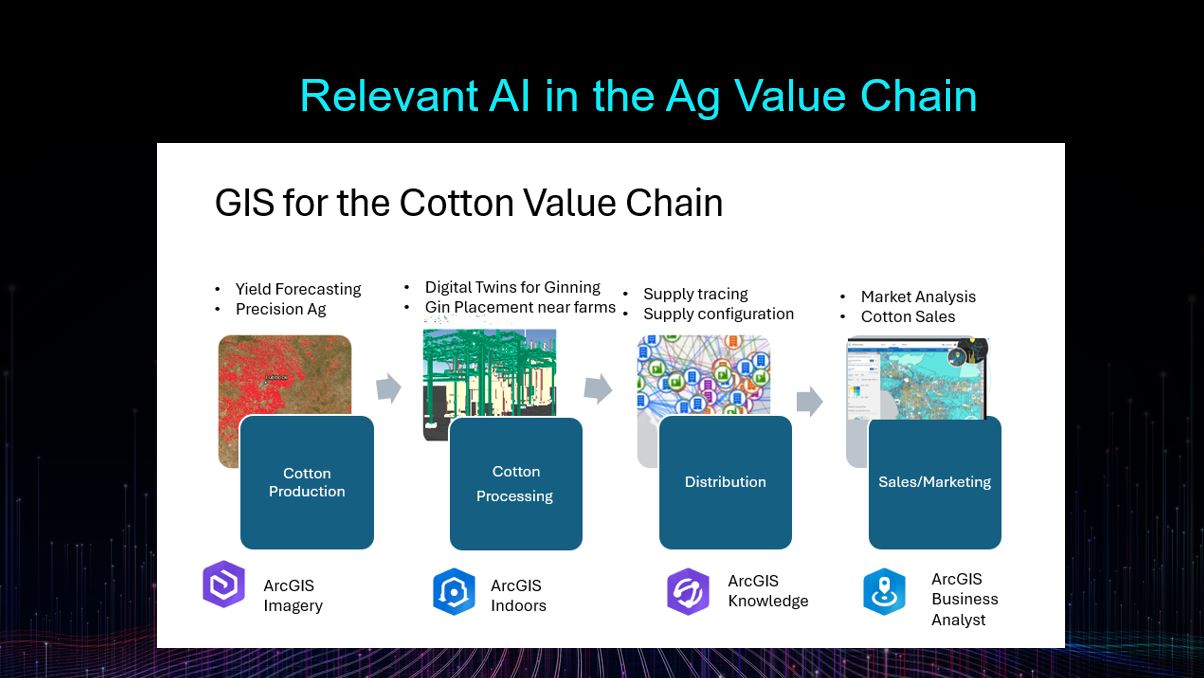
The long answer for agriculture is to focus on carefully inserting AI into existing workflows in the Ag value chain.
Let’s take cotton as an example. Cotton generates roughly $7.1B in US cash receipts, with a third produced in drought-prone Texas, which relies heavily on irrigation from sources like the Ogallala aquifer—expected to dry up within 50 to 100 years. In 2022, about 74% of farmers abandoned their crops and opted for insurance payouts. Field yields influence where processors locate gins to reduce transport costs, affecting the broader supply chain and sales.
AI can be applied in many areas to the Cotton Industry: Spatial Data Science aids market analysis for a variety of cultivars; Knowledge Graphs help configure and bale traceability in supply chains; Digital twins simulate gin operations; and Large Language Models can leverage knowledge graphs of the cotton process and overall state of production.
However, investing in AI for yield forecasting is particularly valuable, as accurate predictions are critical to the entire supply chain. Let's examine this further.
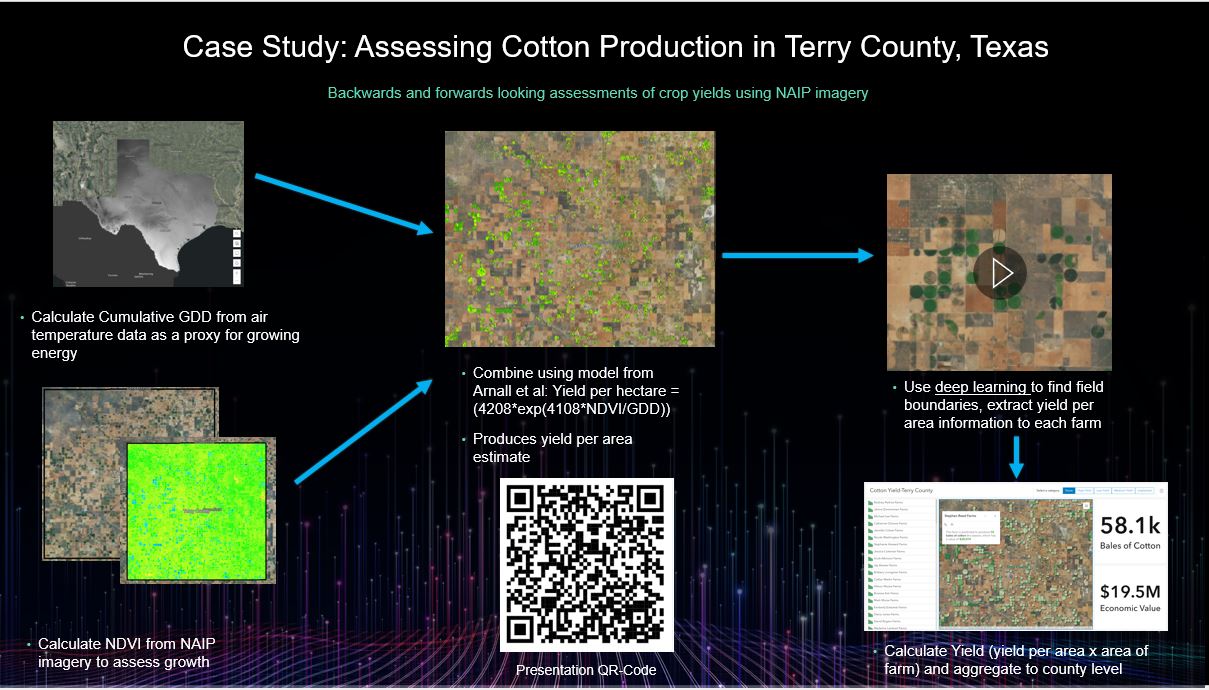
Here's a straightforward example of estimating cotton yield in North Texas by combining temperature and vegetation data based on growing degree days (see presentation on Raster Analytics).
To forecast yield at the field level for informed farming decisions, the system must recognize field locations. This task uses deep learning, and Esri provides pretrained geospatial models that simplify integration into workflows. With predictive forecasts, farmers can identify underperforming areas and consider conservation or other farm management practices to improve outcomes.
While guidance from experts supports this approach, validating results requires structured local input from farmers at the field level—county-level USDA data alone isn't enough. Local knowledge is crucial for building advanced training sets beyond what pretrained models offer.
That's why collaboration with companies like Land O’ Lakes and AC Foods, and the Ag GIS community is vital—they have the trusted relationships needed to verify these models. Esri supplies the tools, but extending AI solutions depends on partners' data and expertise in cooperation with extension services (e.g., Texas A&M AgriLife Extension Service) .
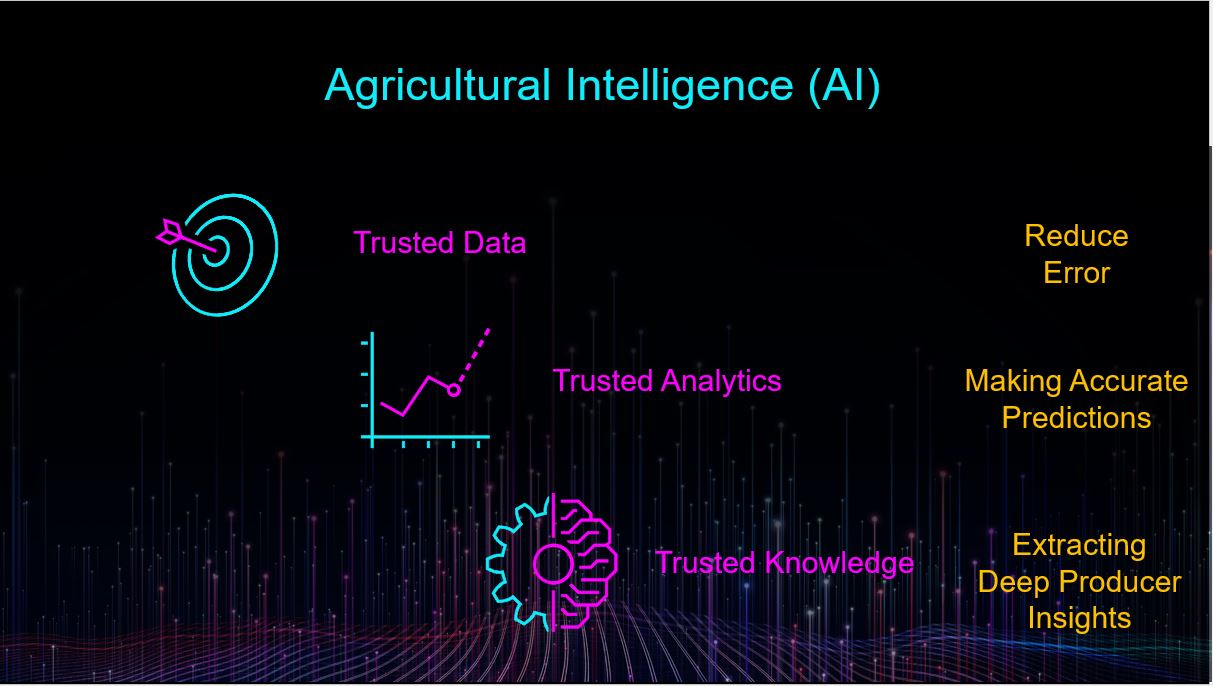
In summary, agriculture is a cautious field where errors can cause significant losses. Our role is to ensure AI is fully implemented, with reliable, trusted data management and analytics systems, while involving local agricultural expertise to maintain trusted knowledge. This approach will ensure that AI truly means Agricultural Intelligence.
The Panel Discussion
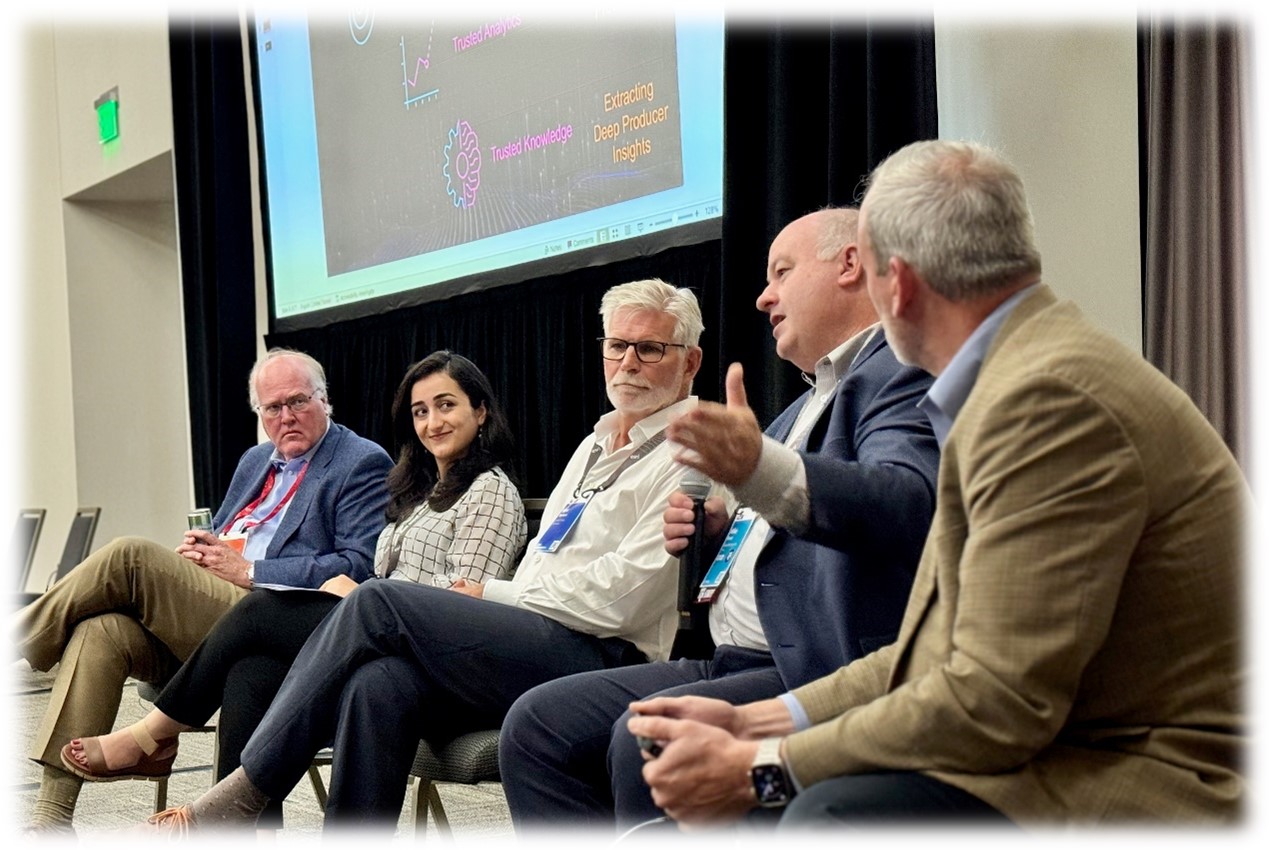
To discuss the role of Agriculture Intelligence, the Ag SIG has representatives from both industry and academia, where panelists included (as pictured below, left to right):
- Nick Short, Ag Industry Solutions Manager, Esri
- Sanaz Havaei, Business Application Analyst, AC Foods
- Kirk Wythers, Business Value Lead, Land O’ Lakes
- Mike Buser, Professor, Endowed Chair in Cotton Engineering, Ginning, and Mechanization, Texas A&M AgriLife
- Mark Dann, Sr. Account Manager, Esri
The panel discussed the following questions:
What opportunities do you see to leverage ML for Predictive Yield Forecasting, and what impact could it have on the business?
“What are some of the ways you are using AI - Advanced Geospatial Analytics in your various businesses and R&D applications?”
The general consensus amongst the group was that trusted AI, like Data Science, depends on a solid data management infrastructure to ensure that the algorithms are fed quality data.