GIS as an Agency-wide Asset at the SC Department of Natural Resources
Back in October, I was grateful to have had the pleasure of being invited to speak at a GIS Symposium during the 2024 Natural Areas Association Conference in Manhattan, Kansas, coordinated by our very own Chris Tracey (NatureServe) and Sunny Fleming of Esri (@LittleMissEsri). It was so inspiring to see all the amazing GIS work being done to protect our natural areas across the country and connect with some of the best amazing conservation researchers and practitioners out there.
This year’s conference theme was ‘Where Science Meets Stewardship’. I latched on to this theme throughout my talk; after all, how better can science meet stewardship than through the use of GIS? This technology cuts through all aspects of natural resource conservation; indeed, it’s on full display at the SCDNR. Our agency has invested in GIS in a huge way in the last 5 years, and as a result it’s used holistically across the department.
______________________________________
The turtle and the forester: a GIS story
 A spotted turtle (Clemmy guttata, G5/S2, State Threatened in SC) wades in a shallow pool of a bottomland hardwood swamp forest in the Sandhills Region of South Carolina.
As an example: Early last year a consulting forester reached out to us in reference to a forest tract slated for clearcut by a private landowner. The forester had run a species review report on the property, so she knew that spotted turtle, a state listed species, had been documented in the vicinity. Wouldn’t you know it? Within a few minutes of arrival to the site, they came across not just one, but several spotted turtles on the property.
The forester was of course concerned, because she ultimately knew the habitat was important for the turtles, and wanted to understand how she might best consult her client (to cut or not to cut?). In the meantime, they shared photos and a location of the turtle observation using our public forms, and within a few days this data was added to the state’s natural heritage database for species of concern and incorporated into a training dataset for improving models to predict suitable habitat across the state.
A few months later, I followed up with the forester to find out if a decision had been made. They were happy to report that the landowner not only decided not to harvest the wood from this habitat but plans to stipulate in an easement that this part of the property is prohibited from timber harvest/development in perpetuity, to protect the species reliant on it (!!!!).
I tell you this story firstly because it’s an AMAZING example of GIS/data informing conservation outcomes (THIS is WHY we do this for a living, right??), but also to highlight that this one story wouldn’t be possible without close to a dozen different GIS tools/apps to make it work. The forester interacted with our data using our ArcGIS Hub sites, with a suite of Experience Builder apps using geoprocessing services on our ArcGIS Enterprise environment. They submitted their data using Survey123. We ingested their data using Python Notebooks in ArcGIS Pro and hosted modelling results on Image server. And the list goes on. If we hadn’t had these tools available to the forester when we did, its entirely possible that this story would have ended in the loss of essential habitat for spotted turtle in SC. So how did we get here?
________________________________________
A successful project sparks ideas…
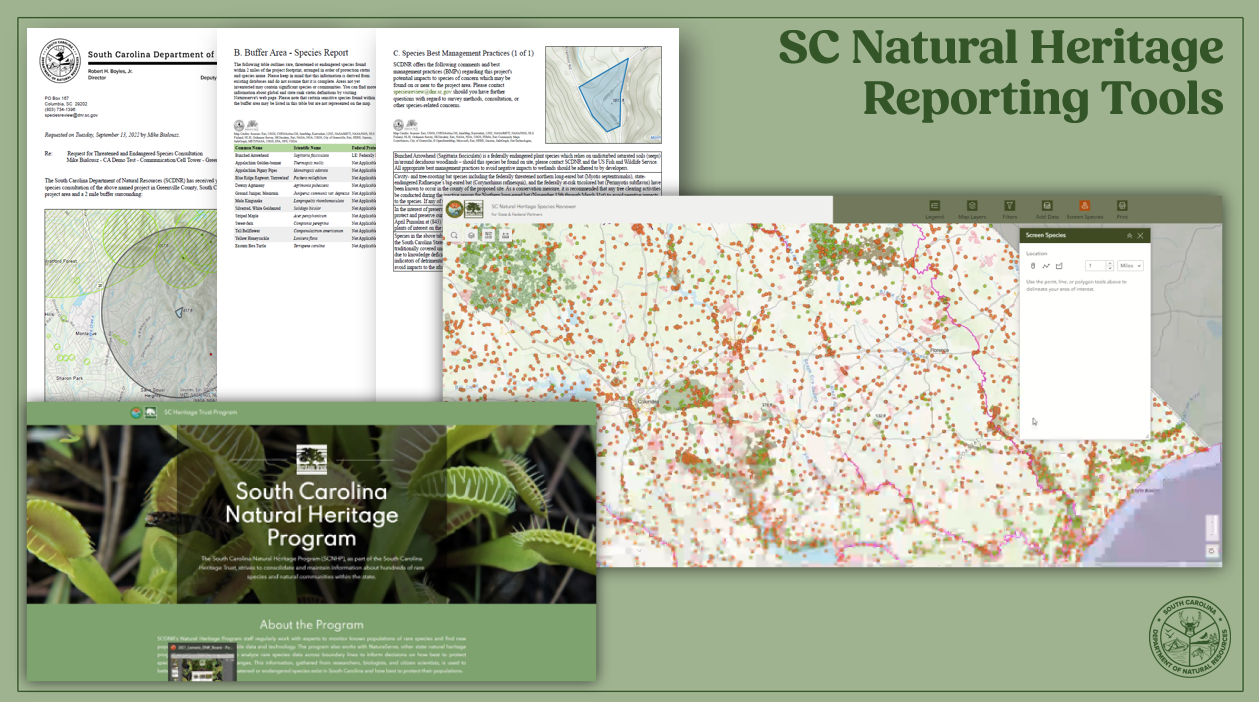
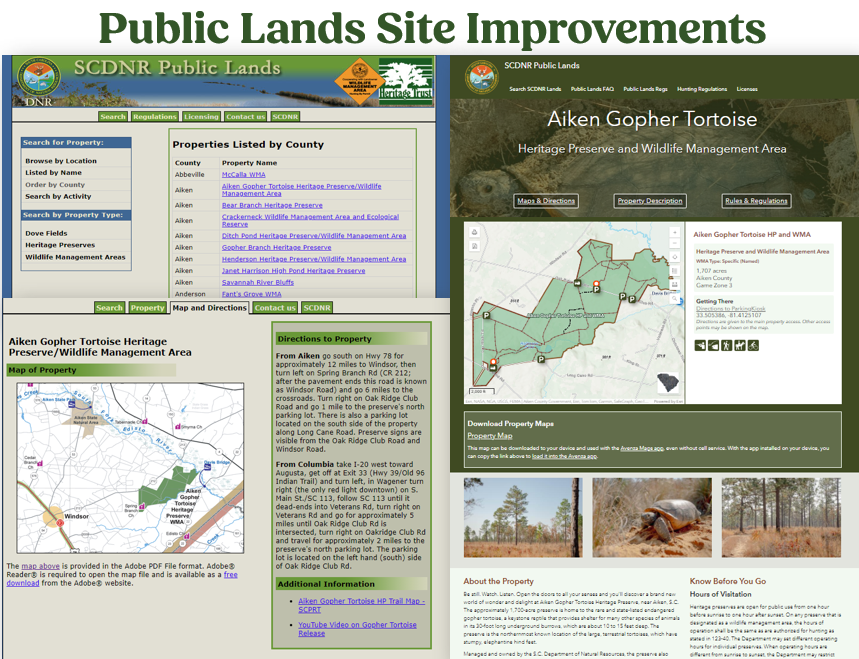
One of my first major projects at the SCDNR involved an overhaul of the Natural Heritage Program’s database of species of concern. Our task was to make data entry more efficient while complying with NatureServe methodology and making the data more accessible to partners and professionals through automation while protecting sensitive data. If these requirements sound familiar, you’re not alone! The quest for making data more accessible and efficient through automation is something that comes up everywhere. “Wouldn’t it be great if we could [insert project here] could be automated?” is a common sentiment in our line of work! Case in point: this year, our outstanding GIS team released a new DNR public lands hub site – a dramatic improvement from what was previously available, paving the way for streamlined data flow.
Long story short, this program overhaul has been a successful project our agency (and others!) point to as an example of what GIS can do if managed end-to-end. Over the years, similar projects have been implemented, growing our portfolio which demonstrates the benefit of location-enabled program management to achieve our agency’s mission. Keeping our mission and vision statements in mind, I think, is one of the reasons we’ve been so successful at our continued growth. As principal stewards for the management/protection of our state’s natural resources, the SCDNR only stands to gain by using GIS to achieve its objectives.
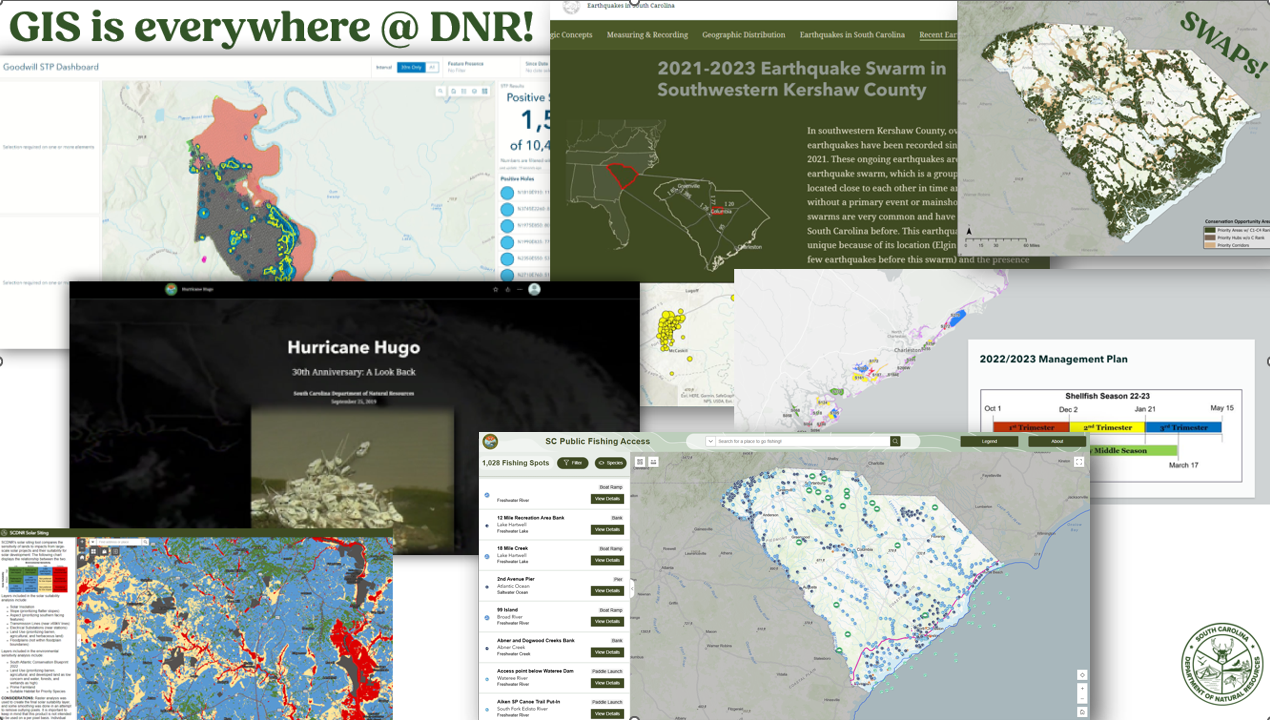
GIS is everywhere at SCDNR! From the early adopters in the Natural Heritage Program (A) and recent improvements to our public lands pages (B) to amazing work going on with our Archaeology, Geology, Marine Resources, Climatology, Wildlife/Fisheries, Land Protection programs, just to name a few (C).
A.
B.
C.
______________________________________________
Finding success
Don’t get me wrong: Getting to a point where GIS is pervasive across our organization wasn’t a snap, didn’t happen overnight, and is still a work in progress. There are a LOT of moving parts to consider, and every organization is different – but I think keeping a few things in mind can help move the needle forward!
Demonstrate benefit – focus on ROI: you can’t argue with measurable results that define success using GIS! Hours of staff time saved, the amount of data collected, or amount of user interaction can go a long way in justifying the need to invest in GIS.
Build relationships, be intentional: Whenever I get the chance, I’m always eager to get out in the field to better understand what our agency does and how GIS could better serve their needs. Ensuring that users are well trained to use (and have had initial input in) the tools we build is critical to a successful project.
Find the champions, be friends: Finding key cheerleaders in your org that know the value of GIS and have an ability to vouch for investment can go a long way. I can sit here and write about how much I love GIS all day long, but if the decision-makers in my organization don’t believe (or even just understand) that it’s critical, it won’t be a priority.
Practice self-care: Go to San Diego (Esri UC), Asheville (Natural Areas Conference 2026), or wherever inspires you! Sharing successful (or maybe problematic!) stories with peers has always been a strong personal motivator for me.
And of course, when in doubt: Eyes on the mission.