The Chattanooga Tree Project (CTP) is a partnership between the city of Chattanooga, the Center for Geospatial Data Science (CAGDS – also known as the “GIS Center”) at the University of Tennessee at Chattanooga (UTC), and two conservation and community-oriented non-profits: Understory by Green|Spaces and the Southeast Conservation Corps. The partnership was formed to plant thousands of trees in Chattanooga, Tennessee to alleviate the impacts of elevated surface temperatures associated with high levels of imperviousness and multi-decadal canopy loss within the city.
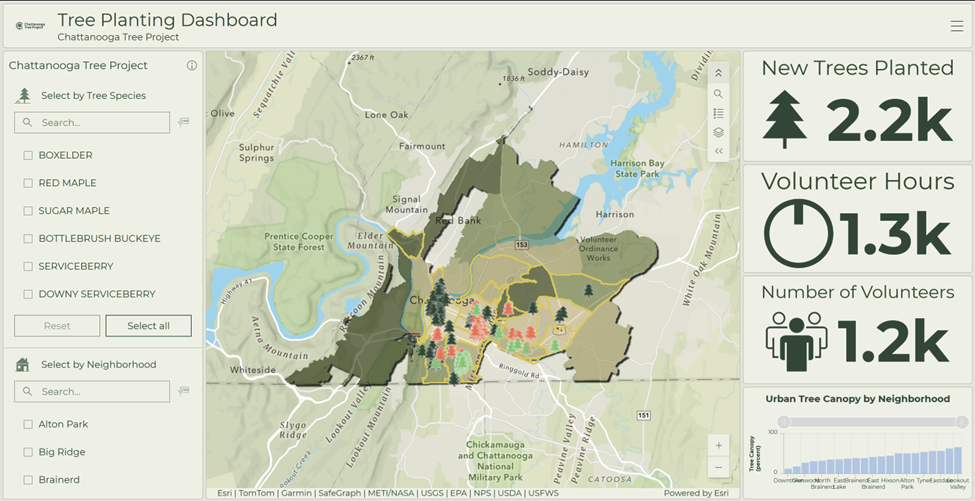
Figure 1: The Chattanooga Tree Project’s Tree Planting Dashboard, a public facing product that can be found on our website at https://www.chattanoogatreeproject.org. Every time a tree is planted in Chattanooga, a new point is displayed on our map, where citizens can get the most up-to-date information on where the trees are being planted.
Hi! My name is Mimi White, and I am a graduate student at the University of Tennessee in Chattanooga. I am proud to have served as the CTP Geographic Research Assistant (GRA) in the GIS Center since the project began in the Fall of 2024. Before this role, I was an undergraduate Environmental Science major whose work in the GIS Center focused on database management, cultural asset inventory, and land cover change analysis using Esri’s Change Detection Wizard in ArcGIS Pro. I credit my experiences here in the GIS center as being integral to my professional development. I even earned some small awards and publications along the way, which is always a wonderful confidence boost.
Perhaps it is a little bit nerdy, but I was having so much fun in the GIS Center that by the time I came to the end of my undergraduate journey, I began actively looking for a way to fund a Master’s degree so that I could stay. It just so happened that CTP funding had been approved around the same time. I applied and was accepted into the Environmental Science Master’s Program at UTC and not long after, was accepted for the GRA.
How Esri Software is Helping us Plant 5,000 Trees in Chattanooga
When the project began, our first goal was to build a model of Chattanooga’s forest canopy cover. Esri’s pretrained deep learning models performed exceptionally well when classifying high resolution imagery out of the box, but later we customized our own deep learning model from training samples generated from high resolution imagery. I used the canopy coverage products from this model to calculate average forest canopy loss Chattanooga experienced from 2014 to 2023. The results of this analysis have been published on the Story Map titled “Mapping Chattanooga's Urban Forests” and is now a finalist in the 2025 Esri Story Map Competition.
LiDAR analysis is another area where we have invested significant effort. We first began experimenting with tree crown delineation workflows using LiDAR data from a 2022 aerial flight over Hamilton County. Rather than reinventing the wheel given the size and scope of Chattanooga’s canopy, we tried one of Esri’s pretrained deep learning packages to classify point clouds as vegetation. After running a script from Esri's tree management solution on the output, our GIS director generated a feature class representing each individual tree in the city. The results of this analysis can also be viewed in the Story Map linked above.
There has been no shortage of new things to learn about. From building Canopy Height Models with LiDAR point cloud data, to analyzing PlanetScope 3-meter multispectral imagery for vegetation health, to automating workflows with Python scripting, every product we are creating has offered something new. Map products, graphs, and figures feed into both internal and public facing dashboards that help CTP partners identify where trees have been planted, where future planting may be needed, and who do we need to engage with along the way. Whenever a set of layers or figures comes together and tells a compelling story, we will attempt to tell that story using a customized Dashboard, Experience Builder, or Story Map to present results or information.
The Esri tools I have found most impactful are ArcGIS Field Maps and ArcGIS Experience Builder. What stands out for me is how easy each of these tools has been to learn and use, and how relevant they are to how we approach community engagement with the plantings. For us, the needs of the community are at the forefront. When trees go into a city-owned right-of-way, it is important that the nearby residents are not only aware of the planting but empowered to give their approval. In a small but meaningful way, this can give neighbors a sense of ownership over the trees. When citizens are proud of their city’s urban forest, there is a higher chance that the urban forest will thrive because it is being protected. On an immediately practical level, Field Maps gives our ground crews a straightforward mobile interface for data entry, protecting privacy and streamlining our reporting process.
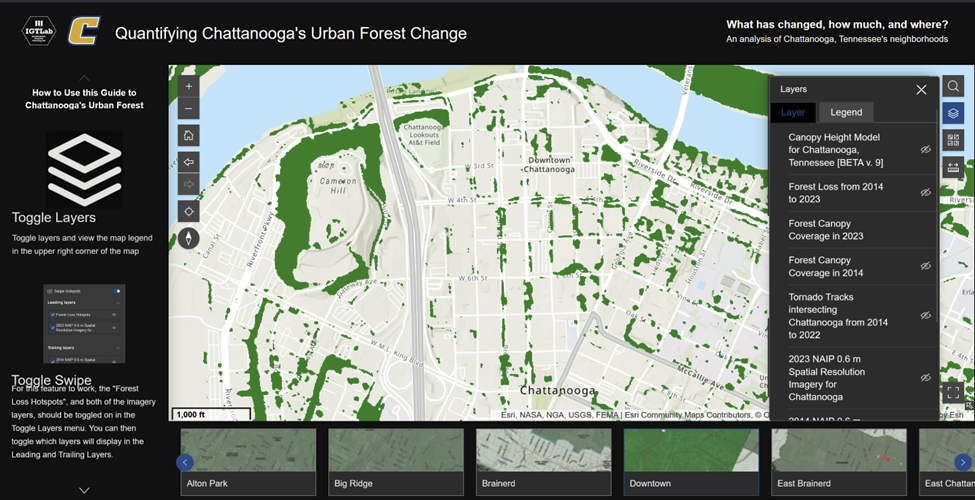
Figure 2: A screenshot of one of our urban canopy models, displayed by neighborhood in an Experience Builder application.
Lessons Learned
As I reflect on the lessons I have learned with the Chattanooga Tree Project, several stand out as having had a strong professional influence. The first came from simple exposure to the planning process. From the beginning, our lab invited all partners to regular GIS meetings. In those meetings, I would showcase the GIS work I was doing, discuss problems I was encountering, and present the data I was using and generating. Meanwhile, our partners would describe the questions they needed GIS to help answer, while my advisors and I brainstormed how we could best tailor our solutions to what the partnership needed. In the beginning, those meetings were my primary window into all the nuts and bolts of turning GIS data into something that happens on the physical surface of the earth.
That exposure taught me a lot of lessons about managing large community projects in partnership with other organizations. When there are so many complex moving parts in a project, the size and scope of CTP, many enthusiastic hands are needed to make something like this work. You must be able to build trust with everyone, and that sometimes happens over time. There will always be tradeoffs, which is why it is important to be honest about what you can deliver and show willingness to ask for help when help is needed, because people are usually excited to lend a hand. Eventually, you begin to build a professional network of humans who are committed to the same things you are committed to.
What’s Next for the Chattanooga Tree Project
There are some exciting things ahead for CTP. We are continuing to plant trees toward our goal of 5,000. At the time of writing this, we have planted over 2,200 individual trees, and the work is ongoing. Lately, we have been asking a lot of questions about ecosystem services. For one, we are investigating methods for modeling carbon sequestration and stormwater runoff reduction potential using data collected on the ground as well as from high resolution multispectral drone imagery and LiDAR. The knowledge gained from these models could eventually help our community leaders find ways to lower service costs, which ultimately benefit citizens. This effort is something I am helping to set up to pass the baton along to the next GRA, as I am approaching the end of my two-year service. Meanwhile, my own time in the GIS Center will continue, as I plan to continue taking on GIS work here while I complete my thesis defense next fall.
Please comment below any of your questions about the project and feel free to connect with me or on LinkedIn.
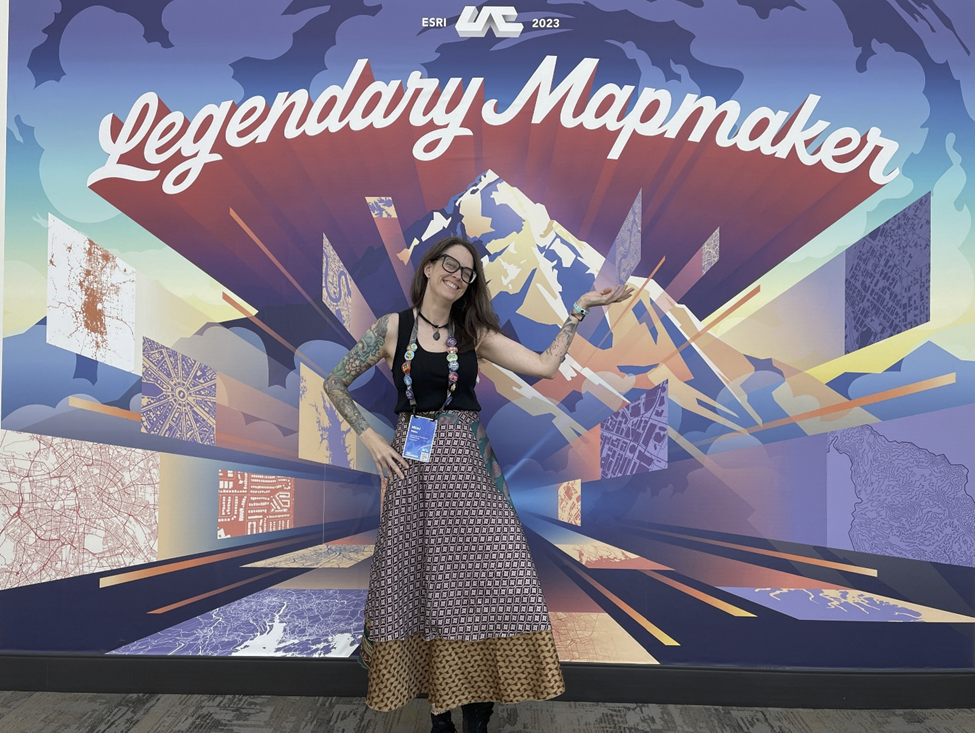
Figure 3. A picture of me at the 2023 Esri User Conference, when I attended as an undergraduate, before I started on the Chattanooga Tree Project. All this time and I’m still obsessed with making maps!