If you are a student or emerging GIS professional, you have probably asked yourself how a career in GIS will change, given that AI can analyze data, generate maps, and write code faster than any individual.
AI is supercharging GIS and making the geographic approach more powerful than ever. Machine learning can classify imagery at scale, detect patterns that humans might miss, automate workflows, and accelerate decision-making. Tasks that once took weeks can now take minutes.
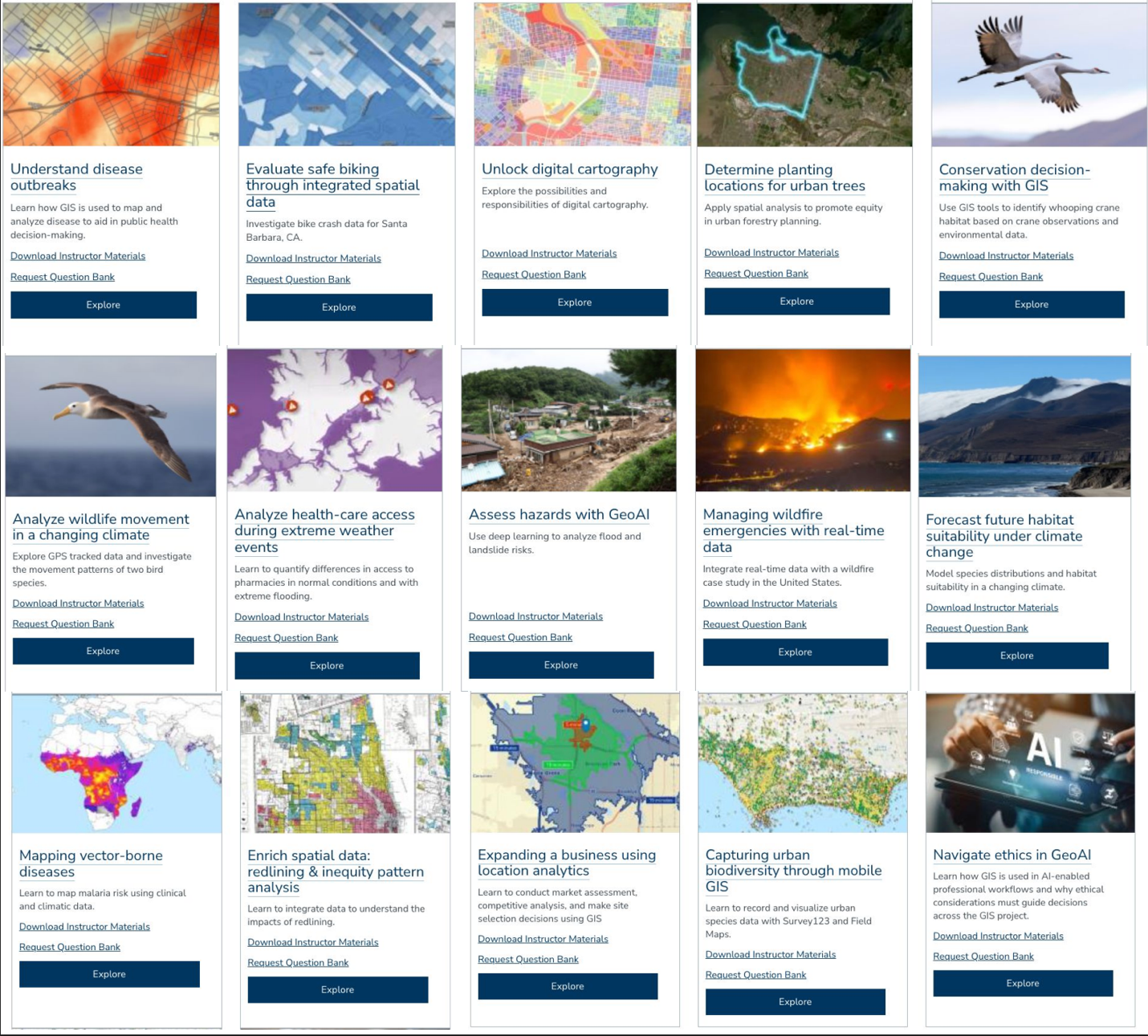
Technological changes like AI, cloud computing and the massive growth in available spatial data have led educators to develop a new paradigm for GIS curriculum: The Guide to the Geographic Approach.
The GIS professional must be able to enter a process where AI stops: framing the right questions, understanding place-based complexity, and defining what “right” outcomes actually look like.
Introducing The Guide to the Geographic Approach
While advanced GIScience students will continue to be the next generation of GIS designers, there is a growing workforce that needs curriculum that teaches how to work with GIS, AI, and GeoAI responsibly and effectively by grounding GIS in spatial thinking, context, and ethics, capabilities that AI cannot provide by its own.
The Guide to the Geographic Approach is a new GIS curriculum that helps students understand why a problem matters and how spatial approaches can lead to solutions. Understanding geographic context, policy implications, or the human consequences of spatial decisions is as important as understanding the geoprocessing steps to create an output or map.
The Guide to the Geographic Approach includes GIS curriculum designed around modern workflows, where AI-assisted tools are becoming the norm. Students learn how to design workflows where automation supports insight. From data preparation and validation to interpretation and communication, the guide emphasizes the role of the GIS professional as a spatial decision-maker, not just a technician. Because the Guide is modular and openly available, it can be adopted in multiple ways: integrated directly into existing GIS courses, used selectively to supplement technical instruction with ethics and emerging topics such as GeoAI and web GIS, or explored independently by students and professionals seeking to strengthen workforce-aligned competencies. With classroom-ready materials, real-world case studies, and alignment to professional standards, the Guide provides a practical entry point for learners to connect tools, context, and responsible spatial decision-making.
The Guide to the Geographic Approach has a strong emphasis on ethics, arguably the most important skill in an AI-driven GIS world. Automated mapping and analysis can influence zoning decisions, disaster response, policing, environmental policy, and resource allocation. The guide pushes you to ask hard questions: Who is represented in this data? Who is not? What assumptions are baked into the model? How might this map be misused?
Redefining GIS Expertise for an Era of AI
AI is not replacing GIS jobs, but it is reshaping them. Employers do not just need people who can run tools; they need professionals who understand spatial context, can guide AI-driven analysis, and can communicate results clearly and responsibly to decision-makers.
GIS has always been about more than maps. In the age of AI, it’s about stewardship—of data, of place, and of impact. The Guide to the Geographic Approach gives you the foundation to thrive in that future, not fear it. With ongoing content creation, check out The Guide to the Geographic Approach regularly to stay up to date on the latest applications, workflows, and ethical considerations in the field of GIS.