Hello lovely humans!
I am analyzing a data set of soil nitrogen levels and want to use Universal Kriging to create an interpolated prediction surface. The data is skewed to the left of a normal curve (no non-zero values, the study site is in an arid ecosystem so most values are relatively small). I am using a BoxCox transformation with a power of 0.5 to help account for the skewedness. The data is also not stationary as it has a strong seasonal influence, hence my choice of Universal Kriging.
I have values for each data point for three separate years (in other words, there are three distinct values for every unique coordinate location sampled) and have been running Universal Kriging through the GeoStats Wizard and selected to use all data points as they represent unique nitrogen values (see screen shot).
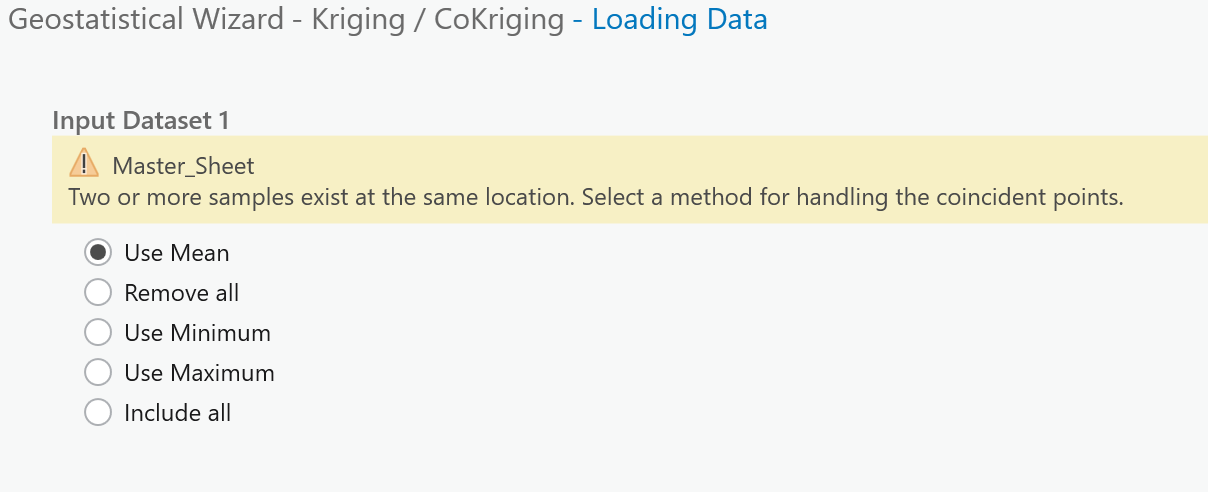
*If you have any feedback on the approach I am using I am open to learning, I have been muddling my way through this on my own and have much to learn 🙂
My main question comes in at this point of the analysis:
I have good reason to think that the season (which strongly correlates to precipitation in this study) with impact the soil nitrogen levels and therefore want to incorporate it into the polynomial being used. I also have two other factors (species and shrub presence) that may also be informative of nitrogen levels and would like to explore their impact on the model. However, I cannot figure out how to specify the constants in the polynomial equations in the Geostats Wizard (in other words, I would like to specify the data that the model uses to identify the constants in the polynomial equation). Is this an option in ArcGIS Pro?
I cannot in good faith use regression kriging as my data is not stationary (unless y'all have some input on how I can control for that).
Any help is much appreciated!