Well, folks,
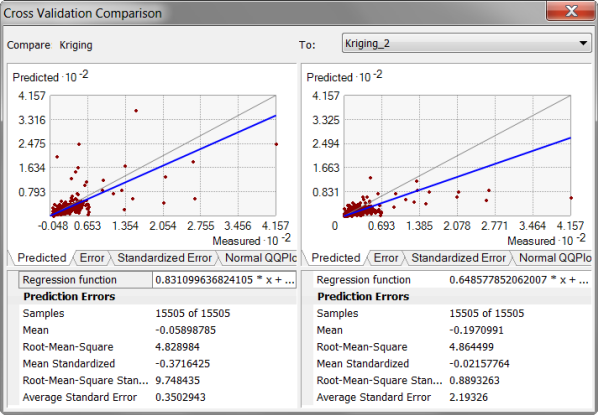
I have a similar query. What does the minus sign in the mean error and mean standardized error indicate? I mean, how does one interpret such a result?
Thanks
Yes, you would want to compare the RMSE between EBK and IDW. A large root-mean-square-standardized usually indicates the model is unstable. The most common reason for this is because the Gaussian semivariogram is very unstable if the nugget is very small, compared to the sill. Note that Stable with parameter=2 and K-Bessel with parameter=10 both correspond to the Gaussian semivariogram (it's a special case of both).EDIT: Oh, I understand what you were asking. It doesn't make much sense to compare RMS and average standard error from different models, but it is useful to compare them within the same model because if the difference between them is large, it indicates that the model may have problems.
There's a typo in that pdf that I just noticed. For average standard error, the formula is missing a square. You can find the correct formulas here:http://resources.arcgis.com/en/help/main/10.1/index.html#//00300000000z000000"Average Standard Error" is the only formula that is different than you might expect. It might be better called "Root-Mean-Variance." We used this formula instead of a simple average because this formula is more directly comparable to the RMS.
http://dusk.geo.orst.edu/gis/geostat_analyst.pdfThe formulas for the crossvalidation summary statistics can be found in Appendix A on page 273 (page 279 of the pdf, since the first six pages aren't numbered).
As for which is better, it's really a judgement call. Personally, I still like the model on the left because both the root-mean-square and average standard error are lower than the model on the right. A large difference between the RMS and the average standard error can indicate model problems, but a root-mean-square standardized of .85 indicates that the problem is not severe in this case. And the one point on the x-axis of the LPI model is also concerning.When we change the graphic, we'll find an example where a lower RMS clearly does not imply a better model.
Ok, we've talked it over, and we're going to change the graphic and some of the text from that topic. The 10.0 web help will update, and it will be changed in a future service pack as well as in version 10.1.Thanks for bringing this to our attention.
Aangemelde leden kunnen berichten plaatsen, updates volgen en meer. Nieuw hier? Registreer een gratis account.
Find useful guides, FAQs, and documents to help you navigate and make the most of Esri Community.