
CHAPTER 2: GOVERNANCE
Introduction
This chapter will focus on defining governance policies and concepts that apply to ArcGIS. Having a governance plan for managing ArcGIS is a key component in planning for institutional implementation, aligning GIS use with the organization’s mission, and ensuring effective use of resources.
Governance
As outlined in Chapter 1: Mission, geospatial technology plays a critical role in advancing teaching, learning, research, and administration across higher education institutions. ArcGIS is no longer confined to a single department or discipline; it is an enterprise system that supports a broad and diverse community of students, faculty, researchers, and staff. As adoption grows, so does the need for clear direction, consistency, and accountability.
This chapter focuses on governing ArcGIS—establishing the policies, decision-making structures, and responsibilities that guide how ArcGIS is accessed, used, managed, and sustained over time. This institutional framework allows you to effectively scale ArcGIS use for broader enterprise adoption, align it with existing policies, and keep your entire IT infrastructure secure, reliable, and sustainable.
Governance is a foundational component of the geospatial framework introduced in Chapter 1. It connects institutional mission and strategy to the practical realities of operating ArcGIS as a system (Chapter 3) and supporting users through communication, engagement, and monitoring (Chapter 4). Without governance, system configuration and user engagement efforts become reactive and fragmented. With governance in place, institutions can make informed, consistent decisions that support long-term success.
In this chapter, you will learn the following concepts:
- What ArcGIS governance means in higher education
- Why governance of ArcGIS is essential
- How governance establishes clarity around roles, responsibilities, and expectations
What ArcGIS governance is
In the context of higher education, governance defines who makes decisions, what is governed, and how policies are established, communicated, and reviewed. ArcGIS governance is the institutional framework for decision-making and accountability that guides acceptable conduct and practices.
ArcGIS governance encompasses institution-wide standards and policies related to access permissions, user information, communication of responsibilities, and system monitoring and maintenance.
- How access to ArcGIS is provided and revoked
- How user information is managed
- How content—data, services, maps, and applications—is created, shared, retained, and deleted
- How communication with constituents about expectations and responsibilities occurs
- How usage is monitored to ensure a healthy and sustainable system
Governance is not the same as system administration. Governance establishes direction, guardrails, and expectations. Administration implements and enforces those decisions through configuration, workflows, and operational practices. This distinction is critical: governance decides what should happen and why, while administration focuses on how it happens. Chapter 3 builds on this governance foundation by describing how policies are operationalized through ArcGIS system configuration and management.
In higher education, governance must also account for the cyclical nature of the academic environment. Each year, there are new students, graduating cohorts, faculty transitions, research projects, and collaborations. Governance provides continuity amid this constant change by ensuring that policies and responsibilities persist even as individuals and roles evolve.
Effective governance does not require inventing new rules in isolation. Instead, ArcGIS governance should align with and extend existing institutional policies. Your institution likely already has policies for identity management, data stewardship, privacy, security, records retention, and communication for other enterprise systems like email, learning management systems, and data storage platforms.
Why govern ArcGIS in higher education
A governance plan for ArcGIS is essential for institutions using ArcGIS as a trusted, enterprise-supported system. Governance is what transforms ArcGIS from a collection of tools into a strategic capability that can grow sustainably across the institution.
Governance helps institutions do the following:
- Plan for growth and scale—As ArcGIS adoption expands across disciplines and administrative units, governance ensures consistent access, predictable usage, and manageable demand on resources.
- Set clear expectations–Governance establishes reasonable expectations for how ArcGIS should be used, what users are responsible for, and what support the institution provides.
- Support informed decision making–With defined policies and monitoring practices, institutions can make data driven decisions about access models, storage, credits, and future investments.
- Reduce risk and ensure compliance–Governance helps institutions align ArcGIS usage with institutional, legal, licensing, security, and privacy requirements, reducing the risk of misuse, data loss, or noncompliance.
- Provide continuity in a dynamic environment–Given the constant onboarding and offboarding of students, faculty, and staff, governance ensures that content, accounts, and access are managed consistently over time.
Governance is especially important in higher education because ArcGIS often serves multiple purposes simultaneously: instructional use, research projects, administrative workflows, and public engagement. Stakeholders in these use cases may have different expectations, privacy concerns, and lifecycle requirements. Governance provides a common framework for balancing flexibility with security.
The governance policies defined in this chapter directly inform how governance decisions are implemented and how governance standards are communicated. Governance ensures that ArcGIS remains aligned with the institutional mission, operationally sustainable, and trusted by the community it serves.
Who governs ArcGIS
Effective governance of ArcGIS in higher education requires shared ownership and clearly defined accountability. Because ArcGIS supports teaching, learning, research, and administrative operations, governance cannot reside within a single department or role. Instead, it must reflect the institution’s organizational structure, policies, and culture, while allowing for coordinated decision-making.
Governance is typically exercised through a cross-functional governance team or council. This group is responsible for establishing policies, setting expectations, and ensuring alignment with institutional priorities. Governance teams do not manage day-to-day system operations; rather, they define the guardrails within which ArcGIS is administered and used. Chapter 3 builds on this foundation by describing how governance decisions are implemented by administrators through system configuration, automation, and operational practices. Governance model overview
A governance team provides a formal structure for the following actions:
- Defining institutional policies related to ArcGIS access, use, and security
- Establishing accountability for governance decisions
- Coordinating across academic, administrative, and IT domains
- Revisiting policies as institutional needs and technology evolve
The goal of governance is not to limit access or innovation, but to ensure that ArcGIS is managed responsibly, consistently, and sustainably as adoption grows across the institution.
Governance roles
Institutions vary widely in size, structure, and maturity. The roles described below represent functional responsibilities, not required job titles. In some institutions, one person may fulfill multiple roles; in others, responsibilities may be distributed across teams.
- GIS leadership and geospatial support—Coordinate governance activities and serve as the primary liaison between governance, system administrators, and the user community. This role often facilitates governance discussions, ensures policies are documented, and helps translate governance decisions into operational practice.
- Enterprise IT and security representatives—Ensure that ArcGIS governance aligns with institutional standards for identity management, cybersecurity, privacy, accessibility, and infrastructure. This role helps reduce risk and ensures ArcGIS is treated consistently with other enterprise systems.
- Data and content stewards—Provide guidance on stewardship of institutional data and content, including authority, ownership, metadata, retention, and disposal. These roles are especially important for administrative, research, and authoritative datasets that have long-term value or compliance requirements.
- Academic and research representatives—Represent instructional and research perspectives, ensuring governance policies support legitimate academic use cases while remaining sustainable. Their involvement helps balance flexibility for teaching and research with institutional stewardship responsibilities.
- Operations representatives—Represent campus facility, finance, and safety. Their roles focus on managing operations and infrastructure.
- Legal, records, or compliance stakeholders (as needed)—Provide guidance on records retention, contractual obligations, sponsored research requirements, and privacy considerations that influence governance decisions.
Decision rights and accountability
For governance to be effective, decision-making authority must be clearly defined. Governance teams are typically accountable for decisions such as the following:
- Who is eligible for ArcGIS access and under what conditions
- How accounts and affiliations are managed over time
- How content is created, shared, retained, archived, or deleted
- How usage is monitored and evaluated
- How exceptions to established policies are handled
Governance is an ongoing responsibility. Policies and decision frameworks should be revisited periodically to reflect changes in institutional priorities, technology capabilities, and patterns of use.
What is governed
Governance defines what decisions are made and what areas are subject to institutional policy. For ArcGIS in higher education, governance typically focuses on a set of core decisions that together support responsible, scalable use of the system.
These decision areas are not specific technologies or configurations. Chapter 3 describes how these governance decisions are implemented operationally, while Chapter 4 describes how they are communicated and reinforced.
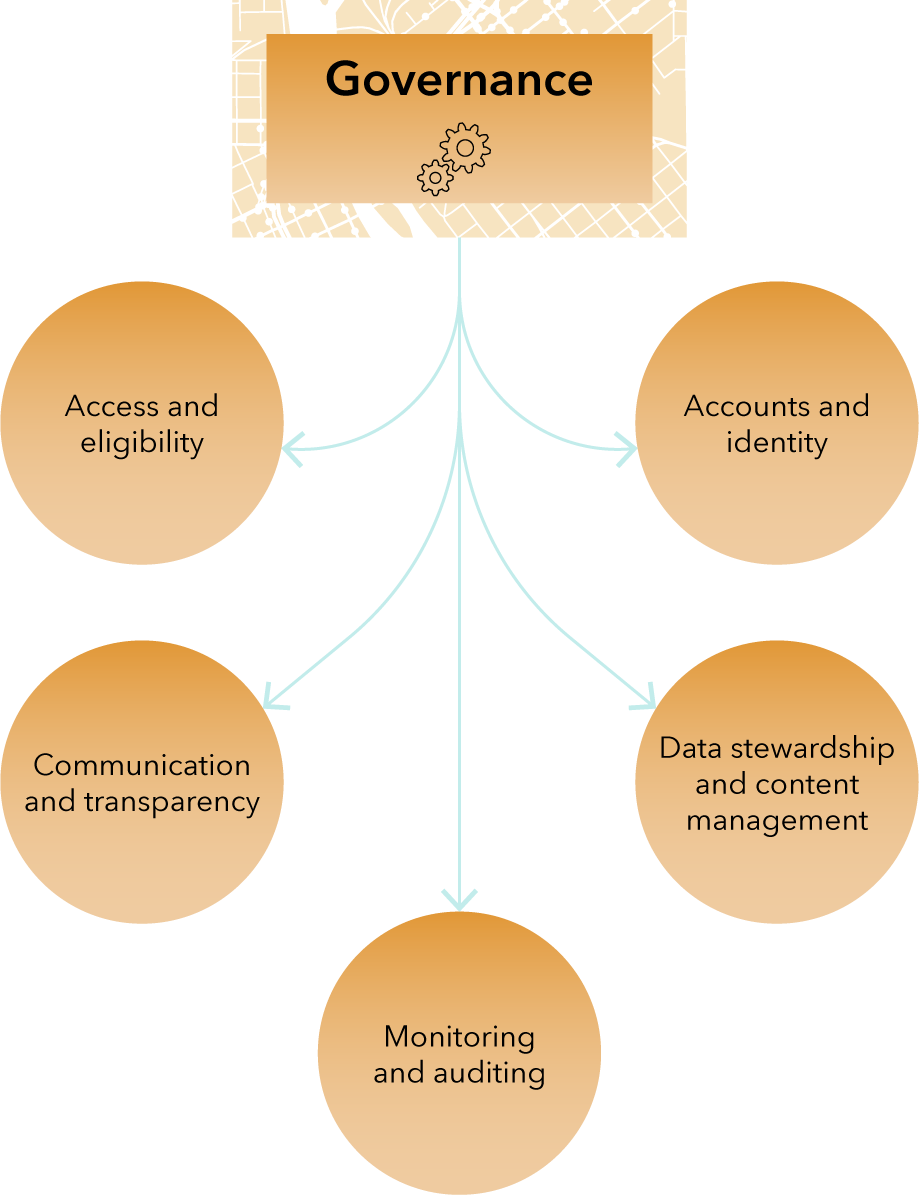
Access and eligibility
Governance establishes who is eligible to access ArcGIS and how access is granted and revoked. This includes the following:
- Eligibility criteria for students, faculty, staff, and affiliates
- Alignment with institutional identity and access management systems
- Consideration of lifecycle events such as enrollment changes, graduation, or separation
Clear access policies help ensure that ArcGIS remains available to authorized users while reducing administrative burden and risk.
Accounts and identity
Account governance defines how user identities are managed within ArcGIS, including the following:
- Account creation and lifecycle management
- Privacy and security considerations for user information
- Alignment with institutional policies governing accounts for other enterprise systems
These decisions directly inform the system configuration decisions you will make and support scalable onboarding and offboarding.
Data stewardship and content management
In the context of ArcGIS, content includes data, services, maps, applications, and other items created or shared within the system. Governance establishes expectations for the following:
- Authority and ownership of content
- Retention, archiving, and disposal of content
- Storage limits and responsible use of shared resources
- Metadata and documentation standards
Data stewardship is especially important in higher education, where content may be created by students, faculty, researchers, and staff with varying account lifecycles and institutional obligations.
Communication and transparency
Governance defines how expectations, responsibilities, and policies are communicated to users. This includes the following:
- Publishing governance policies and guidelines
- Educating users about their responsibilities
- Communicating changes, updates, and lifecycle events
Chapter 4 expands on this domain by describing specific communication strategies and engagement practices.
Monitoring and auditing
Governance also establishes expectations for monitoring ArcGIS usage to ensure system health and sustainability. This includes the following:
- Periodically reviewing usage patterns
- Monitoring of storage, credits, and activity
- Using monitoring insights to inform governance decisions
Monitoring is a mechanism for understanding system health, tracking growth, demonstrating value, and planning for future needs. It is not punitive but rather a means to maintain awareness and address issues before they become problems.
With governance roles defined and governance domains identified, institutions can move from deciding what should be governed to deciding how governance is established and maintained. The next section describes how institutions can develop, implement, and evolve ArcGIS governance policies over time.
How governance is established
Establishing governance for ArcGIS is an incremental and iterative process, not a one-time exercise. Institutions do not need to create an entirely new governance framework from scratch. Instead, effective ArcGIS governance builds on existing institutional policies, practices, and decision-making structures already in place for other enterprise systems.
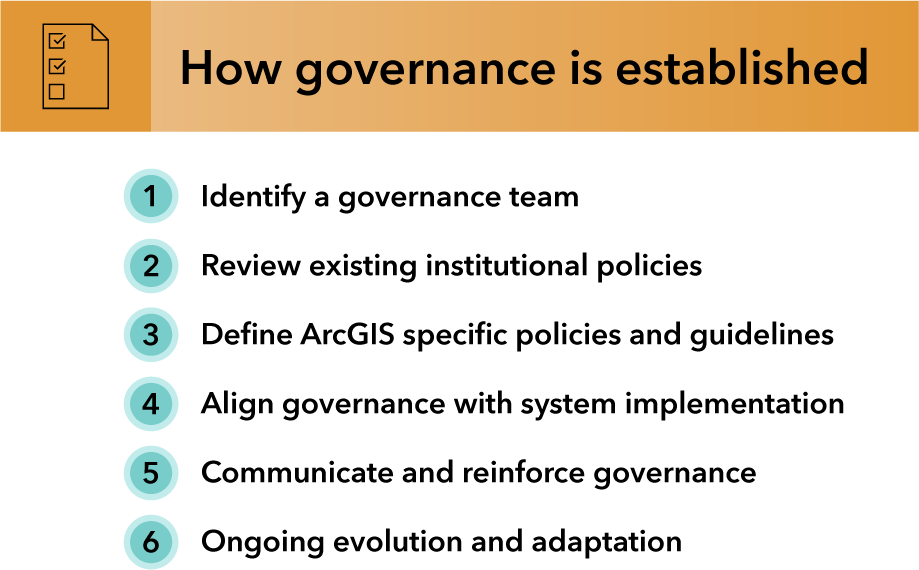
This section outlines a practical approach to establishing governance that aligns with the institutional mission (Chapter 1), informs system configuration and operations (Chapter 3), and supports communication and engagement practices (Chapter 4).
Identify a governance team
The first step in establishing governance is to formalize responsibility. Institutional leaders should identify a governance team or council that is accountable for defining and maintaining ArcGIS governance policies. This team should represent the key stakeholder groups and operate with a shared understanding of institutional goals and constraints.
At this stage, the focus is not on detailed technical decisions but agreeing on a shared purpose for ArcGIS governance, clear ownership of governance decisions, and alignment with institutional mission and policy frameworks.
Review existing institutional policies
First, review existing governance policies that apply to other enterprise systems at the institution. Most institutions already have policies governing access management, data stewardship, records retention, acceptable use, privacy, and communication for platforms such as email, learning management systems, or data sharing services.
Consider the following questions:
- What policies exist for managing access to institutional systems?
- How are accounts handled when individuals join or leave the institution?
- What are the expectations for retaining, archiving, or disposing of institutional data?
- How are users informed of their responsibilities and changes to systems?
The goal is to align ArcGIS governance with existing institutional standards, rather than introducing conflicting practices.
Define ArcGIS policies and guidelines
Once relevant institutional policies are identified, governance teams can define ArcGIS-specific policies and guidelines that interpret those standards for the ArcGIS environment. These policies should focus on the governance domains described in the previous section and reflect the academic context in which ArcGIS is used.
Policies should meet the following standards:
- Be clear, concise, and accessible
- Address the full lifecycle of users and content—from onboarding to offboarding
- Balance flexibility for teaching, research, and campus operations with institutional administration and stewardship responsibilities
At this stage, institutional stakeholders define what the policies are and why they exist.
Align governance with system implementation
Governance decisions must be actionable. Once policies are defined, institutional leaders can assess their existing ArcGIS deployment to ensure it can support those policies. This alignment step bridges governance and implementation.
For new deployments, governance decisions inform how the ArcGIS system is configured from the outset. For existing deployments, governance may require revisiting established practices and introducing new workflows to achieve compliance.
Chapter 3 explores system-wide options for implementing governance decisions related to access, identity, content management, and monitoring.
Communicate and reinforce governance
Governance is only effective if it is understood and reinforced across the user community. Institutions should plan how governance policies will be communicated to users at key points in the lifecycle: onboarding, active use, and offboarding.
Communication requires ongoing engagement, reinforcement, and monitoring to ensure policies remain visible and effective over time.
Ongoing evaluation and adaptation
Governance is not static. Institutions should establish a practice of periodic review and evaluation of governance policies and guidelines. Policies may need to evolve as ArcGIS adoption increases or shifts across disciplines, technology capabilities change, and institutional priorities or policies are updated.
Governance teams should revisit policies annually or when significant changes occur to ensure continued relevance and alignment.
Governance principles
Governance principles provide the foundational lens through which ArcGIS governance policies are developed, evaluated, and applied. Principles are intentionally guiding rather than prescriptive; they help institutions make consistent decisions across diverse use cases, disciplines, and user communities.
While specific policies may evolve over time, these principles establish continuity and ensure governance decisions remain aligned with institutional mission and values, as described in Chapter 1.
Institutional alignment
ArcGIS governance should align with existing institutional policies and practices, not operate in isolation. Governance decisions related to access, data stewardship, privacy, security, and communication should reflect how similar enterprise systems are governed across the institution.
ArcGIS is one component of a broader institutional technology ecosystem. Treating it consistently with other enterprise platforms builds trust, reduces confusion, and simplifies administration.
Good stewardship of shared resources
ArcGIS is a shared institutional resource. Governance should promote responsible use of licenses, storage, and system capacity to ensure equitable access and long-term sustainability.
Stewardship includes the following practices:
- Being mindful of finite resources such as storage and credits
- Encouraging appropriate use based on role and need
- Promoting practices that prevent unnecessary duplication or waste
Good stewardship enables growth while protecting the system for future users.
Clarity of responsibility and accountability
Governance should clearly define who is responsible for what—from content ownership and metadata to managing access and lifecycle events. Clear accountability reduces ambiguity and prevents governance decisions from becoming reactive or inconsistent.
Users, administrators, and governance teams each have responsibilities. Governance principles help ensure those responsibilities are understood and reinforced.
Lifecycle-aware decision-making
Governance must account for the full lifecycle of users, content, and groups—from creation and active use to transition and eventual removal. Decisions should not be made solely for the moment of onboarding or peak usage, but with an understanding of what happens over time.
Lifecycle awareness is particularly critical in higher education, where turnover of users is expected and continuous.
Transparency and communication
Governance is most effective when policies and expectations are visible, understandable, and consistently communicated. Transparency builds trust and allows users to take ownership of their responsibilities.
Clear communication is reinforced through the engagement practices described in Chapter 4 and should be treated as an integral part of governance, not an afterthought.
Flexibility with managed exceptions
No governance framework can anticipate every use case. Governance principles should allow for documented exceptions when justified, while maintaining overall consistency.
Managed flexibility ensures governance supports innovation in teaching and research without undermining institutional stewardship.
Governance across the user lifecycle
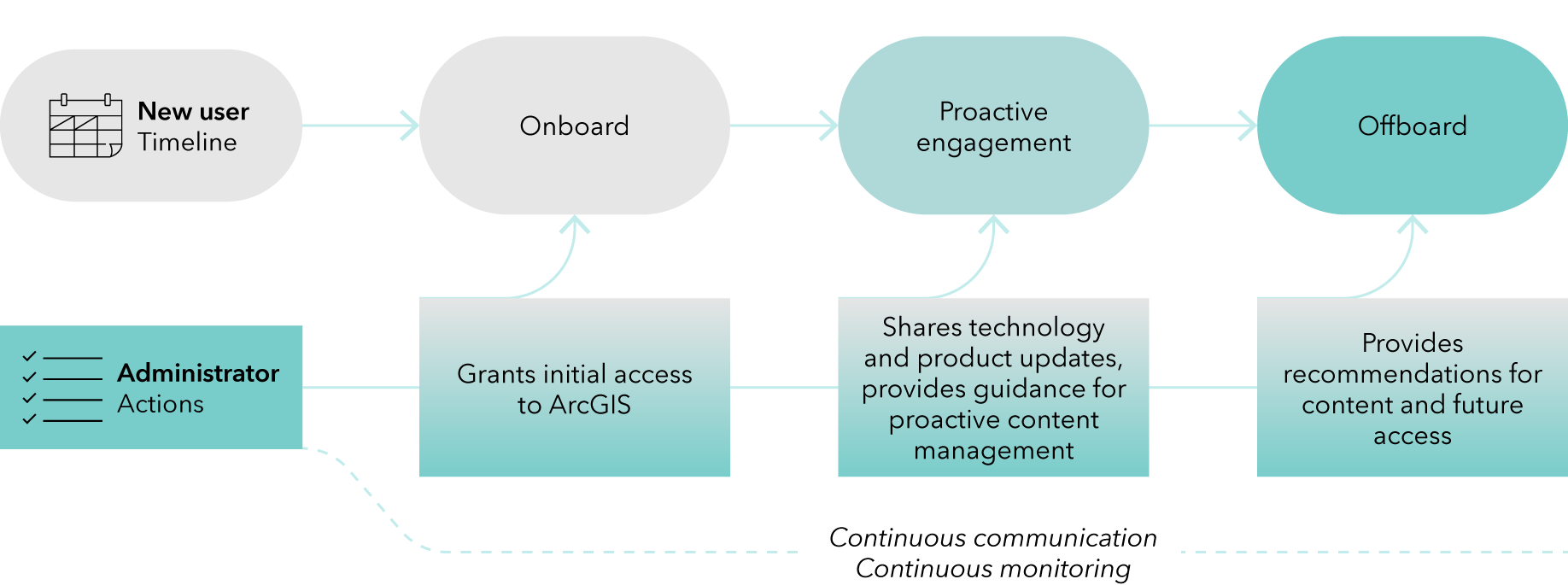
Governance in higher education must account for the dynamic nature of the academic environment. Users regularly join, change roles, collaborate, and depart. Governance across the user lifecycle ensures that access, content, and responsibilities are managed consistently at each stage.
The lifecycle perspective introduced here informs both system implementation (Chapter 3) and engagement practices (Chapter 4).
Onboarding
Governance begins with onboarding. As users gain access to ArcGIS, governance policies define who is eligible for access, what level of access is appropriate, and what responsibilities users assume when using ArcGIS.
Effective onboarding sets expectations early, reduces confusion, and minimizes the need for manual intervention by administrators. Automated and scalable onboarding practices help enforce governance consistently as adoption grows.
Active use
During active use, governance focuses on responsible creation and management of content, appropriate sharing and collaboration, and ongoing stewardship of data, maps, applications, and groups.
Governance during this stage encourages users to manage their own content proactively, follow institutional standards, and make informed decisions about storage, sharing, and collaboration. Monitoring practices provide insight into usage patterns and inform future governance decisions.
Offboarding and transitions
Offboarding is one of the most critical—and often overlooked—phases of governance. As users graduate, change roles, or leave the institution, governance policies define when access should end, what happens to content and groups, and how ownership or stewardship is transferred or retired.
Clear offboarding governance prevents orphaned content, unmanaged storage growth, and security risks. Proactive communication and sufficient notice allow users to take appropriate action before departure.
Continuous reinforcement
Governance across the lifecycle is not linear or static. Users may move between roles, collaborate across departments, or re enter the institution in new capacities. Governance must be reinforced continuously through communication, monitoring, and periodic review.
Chapter 4 expands on how institutions can support this reinforcement through engagement strategies, while Chapter 3 describes how lifecycle governance is operationalized within the ArcGIS system.
With governance principles established and lifecycle considerations defined, institutions are prepared to evaluate and refine governance practices over time. The next section focuses on ongoing evaluation and continuous improvement of ArcGIS governance.
Ongoing governance and continuous improvement
Governance is not a one-time activity. As ArcGIS usage grows, evolves, and diversifies, governance policies and practices must also adapt. Ongoing governance ensures that ArcGIS continues to align with institutional mission, policies, and priorities while remaining sustainable and responsive to change.
Continuous improvement allows institutions to move from initial governance adoption to a mature governance practice—one that is proactive rather than reactive, informed by usage patterns, and grounded in institutional learning.
Periodic review of governance policies
Institutions should establish a regular cadence for reviewing ArcGIS governance policies and guidelines. At a minimum, governance should be revisited in the following scenarios:
- Annually
- When significant institutional policy changes occur
- When there are major shifts in ArcGIS usage, scale, or adoption
- After significant technological changes or new capabilities
Regular review ensures that policies remain relevant, clear, and aligned with current institutional needs. It also provides an opportunity to retire policies that no longer serve their intended purpose or to clarify areas that have created confusion.
Using monitoring insights to inform governance
Monitoring plays a critical role in continuous improvement. Usage insights—such as patterns of access, content growth, storage consumption, and activity trends—provide evidence that can guide governance decisions.
Monitoring should be used to do the following:
- Identify emerging patterns of use or misuse
- Understand where policies are effective or need refinement
- Anticipate future needs for system capacity or access
Rather than serving as an enforcement mechanism alone, monitoring supports informed governance by revealing how ArcGIS is actually used across the institution.
Adapting governance as the institution evolves
Higher education institutions are dynamic. New academic programs emerge, research priorities shift, technologies evolve, and user communities change. Governance must be flexible enough to accommodate these changes without sacrificing consistency or accountability.
Governance teams should expect to adjust policies as new use cases arise, revisit role definitions as responsibilities evolve, and refine lifecycle practices as onboarding and offboarding patterns change.
This adaptability ensures governance remains supportive of innovation while maintaining institutional policies.
Reinforcing governance through practice
Governance is reinforced not only through written policies, but through consistent practice. Alignment between governance decisions, system configuration (Chapter 3), and engagement practices (Chapter 4) strengthens the credibility and effectiveness of governance over time.
When users experience governance as predictable, transparent, and fair, they are more likely to take ownership of their responsibilities and contribute to sustainable use of ArcGIS.
Governance as an institutional capability
Ultimately, effective ArcGIS governance becomes an institutional capability—embedded into how technology is managed, supported, and evolved. Institutions that invest in ongoing governance position themselves to do the following:
- Sustain ArcGIS as an enterprise system
- Support long-term growth across disciplines
- Reduce risk and administrative burden
- Demonstrate the enduring value of geospatial technology
Governance maturity is achieved not through rigid enforcement, but through continual learning, collaboration, and alignment with institutional mission.
Governance provides the foundation that connects institutional mission to system implementation and user engagement. By defining decision making structures, governance domains, guiding principles, and lifecycle practices—and by committing to continuous improvement—institutions can ensure that ArcGIS remains a trusted, sustainable, and impactful component of their technology ecosystem.
With governance in place, institutions are prepared to turn policy into practice.
Take action
Use this checklist to create a summary of policies and guidelines applicable to ArcGIS in the following domains:
- Access and eligibility
- Accounts and identity
- Data stewardship and content management
- Communication and transparency
- Monitoring and auditing
Consider the following as you define your policies:
- Access and eligibility—Create policies for general access and eligibility. Include information on how ArcGIS is accessed and supported.
- Create policies for account information that include account provisioning, how long to keep user accounts, and how long accounts stay active after separation. This will help answer questions such as “When is the right time to delete users?” There is no single correct answer.
- Think about your institutional policies that you researched earlier. Who is authorized to access software applications such as ArcGIS and for how long do they retain access? Your institutional governance policy will define what this means. What should an administrator do with the user’s content and groups before deleting user accounts?
- Data stewardship and content management—Create policies for retention and disposal of content, as well as the amount of storage allowed. Include information such as the following:
- How long should content be preserved at your institution?
- When should content be deleted?
- How should content be deleted?
- How much data are users allowed to maintain in the system?
Keep in mind that there is no one-size-fits-all solution. It varies depending on your organizational policies and standards.
You can review a sample message for users leaving the university: Messaging for ArcGIS Online users leaving the university (students, faculty, staff). This kind of communication can be shared with your users.
- Communication and transparency—Create policies for communication.
- Proactively inform users of their responsibilities. Post guidelines and policies publicly.
- Empower users within your organization to be self-sufficient and help themselves. Include information such as the following:
- How to access ArcGIS
- What to do with existing content and groups
- How to dispose of their groups and content before they leave
- What happens after graduation?
- Provide updates. Include information such as the following:
- When updates happen to any of the apps (ArcGIS Pro, web apps, mobile apps)
- When new capabilities are added to ArcGIS and appropriate privileges to user roles are updated
- When a product is being retired
- Monitoring and auditing—Create policies for monitoring.
- How will you monitor ArcGIS?
- How often will you analyze feature data store usage level, tracking credit consumption, app usage, and member activities?
- Will you use ArcGIS Dashboards?
Next Steps
Read the rest of the chapters:
E-book PDF will be available soon.
Contact your Account Manager or highered@esri.com with any questions.
