For research purposes, I aim to detect the number and estimate the shape area of swimming pools on Rhodes Island using the pre-trained deep learning model Pool Segmentation - USA. However, I am currently facing challenges related to both the accuracy of the detection results and the processing time of the input data. Below, I outline the full workflow I’m following:
Step 1: Data Preparation
Due to the lack of high-resolution imagery in a format compatible with the pre-trained model, I am using World Imagery Wayback basemaps to manually export imagery in .tpkx or .tif format for areas where pools are visually identified.
- When exporting in .tpkx, I convert the files to 3-band 8-bit TIFFs using a Python notebook.
- After collecting all the relevant .tif files, I use the Mosaic to New Raster tool in ArcGIS Pro to merge the inputs into a single raster dataset. This prepares the data for model inference.
Step 2: Running the Model
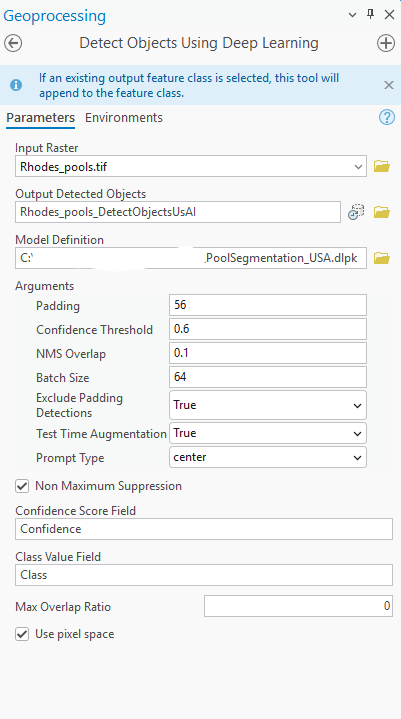
Once the raster is ready, I use the Detect Objects Using Deep Learning tool in ArcGIS Pro:
- Input: the merged .tif raster (3-band, 8-bit), which in my case is ~2.3 GB.
- Model: Pool Segmentation - USA with default parameters.
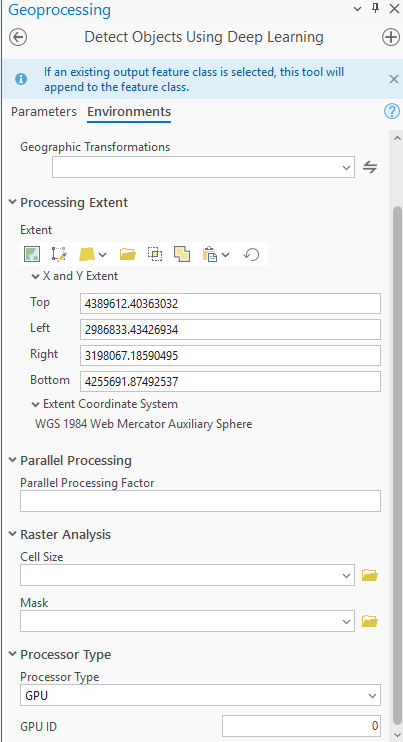
- Processor type: GPU
- Hardware: I run the model on a Virtual Machine with the following specs:
64 GB RAM, Intel Xeon Gold 5220R CPU, and NVIDIA A10-12Q GPU.
Issues Encountered
- Accuracy: In tests with smaller input areas, I noticed that the model often fails to detect several visible pools.
- Performance: Despite utilizing a GPU, processing the full mosaic raster takes a significant amount of time, or in some cases, the model unexpectedly fails to run altogether.
Request for Suggestions
Do you have any recommendations to improve either:
- The data preparation process (e.g., optimal input resolution, format, preprocessing), or
- The model inference step (e.g., parameter tuning, tiling, hardware optimization)
in order to increase the efficiency and accuracy of the final outputs?