INTRODUCTION
Regardless of the sector we work in or what rung of the ladder we’re on, we all have goals, motivations, and a sense of where we want to go. Yet the path to get there is often riddled with doubts. We started talking about our own fears, asking: Are these fears real – or just myths we’ve grown up believing about what’s possible (or impossible) for us? What we found is that fear is very real in shaping our decisions – whether it’s based on fact or fiction. Workplaces often act like emotion-free environments where we should leave [personal challenges] at the door, but of course we don’t really leave our full selves at home. We bring everything to work: hopes and anxieties about advancement, biases we’ve faced, and the stress of a shifting economy or technology. Those unacknowledged tensions can fester in silence, chipping away at our confidence and well-being.
Realizing we weren’t alone, we (Julie and Caleb) set out to create Fears & Careers – a safe, anonymous space for people to share their stories. We surveyed professionals across industries and career stages and asked them to open up about the fears they’ve faced. They did so with remarkable honesty and courage. Now, with their permission, we share their wisdom here. These anonymous voices remind us that the first step toward overcoming a fear is acknowledging it – and that none of us have to face these struggles alone.
Throughout this piece, you’ll read many of those stories. They often resonate with our own experiences. Like us, many of our survey respondents felt the sting of doubt and bias. Our hope is that by seeing these challenges named and discussed – by people like us – we can begin to move through them. We have done the heavy lifting for you, so you don’t have to face these fears alone. By preparing our minds, our skills, and our support systems today, we can step into tomorrow’s opportunities with confidence. Let’s uncover the myths, step out of our shells, and discover not just who we are, but who we can become.
CORE FEARS
In our survey and conversations, we repeatedly heard about impostor syndrome, ageism, burnout/work-life balance, job insecurity, and discrimination. Below we dive into each of these, using our own words and the stories people shared.
IMPOSTOR SYNDROME
Impostor syndrome is that nagging voice that says you don’t belong, no matter how much you’ve achieved. Impostor syndrome makes you second-guess your abilities or have a fear of being "found out" even when you’ve earned every bit of your success. As it turns out, this fear is extremely common. In our survey, 71% of respondents said they had felt like an impostor at some point. It doesn’t care how many degrees or accolades you have; sometimes the harder you work, the louder that voice becomes.
What surprised us most is how many seasoned pros still feel it. One survey participant told us about a former professor turned colleague: despite her status, she “still grapples with those feelings of self-doubt”. Another marketer shared how, upon becoming a director, she actually stepped down one level due to that fear – and later fought it by pushing herself. She started public speaking, leading meetings, joining boards, and “getting comfortable with being uncomfortable”.
The good news is many of us have learned to reframe impostor feelings as a sign of growth. One respondent put it simply: “You will always face imposterism in the workplace if your career is headed in a good direction… My department is filled with people who have been in this career for decades… I always feel like I am behind the 8 ball… but there are also things that I can specialize in… One day you will be them, especially with the aging workforce.” In other words: if you feel behind, that’s just a clue you’re learning. We remind ourselves that not knowing everything is normal. Instead of fearing what we don’t know, we look for opportunities to learn new skills. We celebrate each milestone, document our accomplishments, and lean on our mentors and peers for perspective. Over time, being our own cheerleaders and seeing others face the same feeling makes the impostor syndrome lose its power.
AGEISM
Age bias – at both ends – is a fear that many of our respondents named. Workplaces span generations and should benefit from that diversity, but unfortunately stereotypes often sneak in. Younger professionals can be unfairly labeled as inexperienced or entitled; older professionals can be assumed to be out of touch or resistant to new technology. One Gen Z GIS professional captured this well: “Often, I feel as though people are hesitant to hire people labeled ‘Gen Z’... I feel as though we are looked down upon for being technologically savvy... I feel as though I have been turned down from jobs due to my lack of experience, yet in my fellowship I have been given minimal chances to grow... They want us to do the boring work but don’t trust us to actually be leaders and managers.”
That frustration – of being given tasks but not chances to shine – led her to say she’s hopeful she’ll land something soon. She’s not alone. Conversely, another respondent described his mid-career experience: “At my first three jobs I felt subtly that my opinions and expertise were discounted because of my age. Now that I’m older (10 years into the industry), that is not an issue anymore”. In other words, both feeling too young and later too old are real fears.
What helps us combat ageism is staying open-minded on all sides. We remind ourselves that each generation brings strength. A multigenerational workforce should be a powerful advantage. Fresh ideas from newer employees can combine with seasoned insight to make stronger teams. If we stay curious, we can learn from every stage of experience instead of falling prey to stereotypes. By acknowledging that bias hurts all of us, we can choose to trust our collective skills rather than dwell on age.
BURNOUT & WORK–LIFE BALANCE
Burnout was a theme that came up over and over. It’s the fear (and reality) of burning out from pushing too hard without enough rest or support. One professional shared how she had thought “in order to achieve my career goals, I had to sacrifice my happiness and deal with constant stress and anxiety… But the truth is, we don’t have to live like that”. That realization – that balance is possible – took time, and she’s “still working towards” that ideal balance.
When we push ourselves too long without enough rest, recognition, or alignment with meaningful goals, your energy starts to fade, and even tasks you once enjoyed can feel like a burden. It’s easy to internalize that as failure or lack of motivation. In reality, burnout is a sign that something deeper needs attention. When we hit that wall, it doesn’t mean the road is over; it means we need to pause and reassess our path.
One takeaway from our community is to give ourselves permission to set boundaries. It’s okay – necessary, even – to prioritize our well-being. As one respondent put it, we are not obligated to stay in environments that drain us. Instead, we can invest time in opportunities that “support our growth, both professionally and personally… You have every right to build a life where your work supports you, not consumes you”. That might mean negotiating remote work, seeking employers with better support, or, if needed, switching roles. It certainly means leaning on support networks and professional help when needed. Burnout doesn’t have to be a career death sentence – it can be a wake-up call to make intentional changes and rebuild a more sustainable path.
JOB INSECURITY
Many of us also carry fears about job security. Economic shifts, hiring freezes, and new technologies (like AI) raise doubts: Is my job safe? Am I learning the right skills? The recent hype around AI, in particular, left some feeling anxious. As one interviewee noted, we see headlines about AI and fear it “taking over the world". But we try to stay grounded. AI is a tool, not a replacement. While some industries are undergoing dramatic shifts, AI is not a complete replacement for human expertise — it’s unlikely to be. Human professionals will continue to be essential. In our experience, staying adaptable and proactive about learning new skills is the best defense. Whether it’s AI or any other disruption, those who keep updating their skill set and mindset position themselves to thrive with innovation, not be displaced by it. In the face of hiring slumps or rejections, we also remind each other that rejection is not a reflection of our worth. Every survey respondent who told a story of rejection ultimately emphasized: keep learning, keep connecting, and keep going. Uncertainty can be scary, but it can also push us to explore new directions we hadn’t considered.
DISCRIMINATION (BIAS & BELONGING)
A painful fear many shared was that of discrimination – of being judged or held back because of who they are. Gender bias and sexism came up repeatedly. For example, one early-career woman wrote about her first job: “This was my first job out of college, and this was the last thing I was prepared for. I had to get used to not being taken seriously because of my age and gender… My bosses were all men, and I didn’t feel that they understood why it was so uncomfortable for me when I tried to broach the subject.”
She eventually found allies on her team and things got better, but it “never got to be fully comfortable.” Another professional (a white woman) described battling a “boys’ club” mentality: “It feels like I have to constantly prove myself, not only because of my age but because of my gender… There’s this unspoken expectation that women, particularly younger ones, don’t belong in these spaces”. She acknowledged that being a woman of color would make things even harder, but even in her case, those biases had a big impact on her journey.
Race and ethnicity also factored into fear. As one respondent shared, “I worked for a company where I was a racial minority. I often felt excluded and on the outside, and that I would never advance in the company beyond middle management”. Another, a young woman of color, told us that while generally her experience has been good, she still “occasionally…has concerns about bias and inclusion”, noting that subtle dynamics can be hard to navigate when you’re underrepresented. These stories remind us that bias – whether overt or covert – undermines people’s sense of safety and belonging at work.
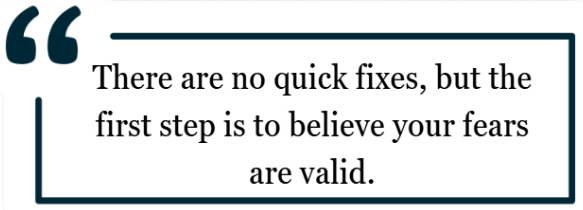
We don’t have quick fixes, but the first step is to believe these fears are valid. We keep company (and conversation) with others who’ve had similar experiences. And we push for change in our spheres: talking openly about bias, updating workplace policies, and demanding diversity in leadership can help chip away at these problems. As community members, sharing these stories and supporting each other is itself a powerful form of advocacy. In an inclusive workplace, differences in outlook and identity are assets – and when we learn from each other, everyone benefits.
CONCLUSION

Writing this together has taught us one big truth: everyone is scared sometimes. We’ve heard it again and again in the voices of our colleagues: whether at 23 or 63, people worry about their jobs, their future, and their worth. These experiences can feel isolating and overwhelming but… you are not alone. None of us are immune to doubt, frustration, or exhaustion, but none of us have to face them alone. In fact, acknowledging our fears is a strength – it’s the first step toward growth, healing, and meaningful change.
Here’s what we’re taking from all the stories we’ve gathered: fear is real, but it doesn’t mean we’re broken. It means we’re doing something that matters to us. By speaking openly about our fears, we chip away at the silence that makes them harder to bear. This community we’re building – each anonymous survey response, each shared insight – is proof that courage grows when we are together.
So whether you’re an early-career pro worried about getting started, a mid-career person questioning your path, someone embarking on a big pivot, or nearing the end of your career, remember: your story matters, your voice is powerful, and your path forward is still unfolding. Prepare today (mentally, skill-wise, and emotionally), show up tomorrow, and know that you are capable of more than you think. Our journeys may not be linear (think more spiral staircase), but every step – even sideways or down – brings new perspectives. We can take those steps together, supporting and cheering each other on along the way.
RESOURCES
To support your journey, here are a few places and tools fellow professionals have found helpful:
- Mentorship & Community: Vanguard Cabinet programs, Geospatial Professional Network (formerly URISA) Mentorship Network, Women+ in GIS Circle Platform, and LinkedIn GIS/industry groups provide peer support, networking, and mentoring opportunities. Organizations that focus on racial, gender, and social equality: NorthStar of GIS, Black Girls M.A.P.P., GeoChicas
- Skill-building: Online learning platforms (Coursera, edX, Udemy, etc.) offer courses to update both technical and soft skills, and Toastmasters International is a great way to build confidence in public speaking and leadership.
- Well-being & Support: Many employers offer Employee Assistance Programs (EAPs) for confidential counseling. There are also great therapy resources (e.g. PsychologyToday, Therapy for Black Girls, Open Path) and crisis lines (988 in the U.S.) for mental health support. Remember, seeking help is a sign of strength.
- Purposeful Transitions: For experienced professionals exploring encore careers or giving back, programs like ReServe offer meaningful opportunities to apply their skills in nonprofit settings. Participants typically engage in part-time, mission-driven roles for about a year in cities like New York, Boston, South Florida, and the Mid-Atlantic region. It’s a great way to stay engaged, contribute, and transition with purpose.
Your career journey is uniquely yours, but we hope these stories, insights, and resources remind you that you have a whole community behind you. Together, we can face our fears, bust the myths, and keep growing.
SOURCES
All quotes and insights are drawn from the authors’ survey and draft articles (Olamiposi Caleb Fagunloye and Julie Lazor) with respondents’ permission. Each blockquote is cited. These resources and reflections are meant to inform and empower professionals across sectors and stages. Thank you! Reach out if you would like to support keeping this conversation going.
If you are interested in reading our full article, please check it out at:
Fears In Careers: Myths, Realities, And The Courage To Grow | LinkedIn