In this blog post, we walk through the details of setting up a new ArcGIS GeoAnalytics for Microsoft Fabric account. For this discussion, we are assuming that you have already purchased a subscription through Microsoft’s Azure Marketplace.
Within a few business days after the purchase you will receive an email from Esri with the subject “Activate your ArcGIS GeoAnalytics for Microsoft Fabric Account.” This email will have the information needed to activate the subscription and create your account credentials.
Subscription activation
Your activation email will include a URL to activate the subscription. This URL is specific to your account. You will use it to set up user credentials to use in authentication with GeoAnalytics for Fabric. By clicking on that link, you will enter the setup process where you will:
- Provide an Organization Name. This is the name that will appear on your GeoAnalytics for Fabric dashboard.
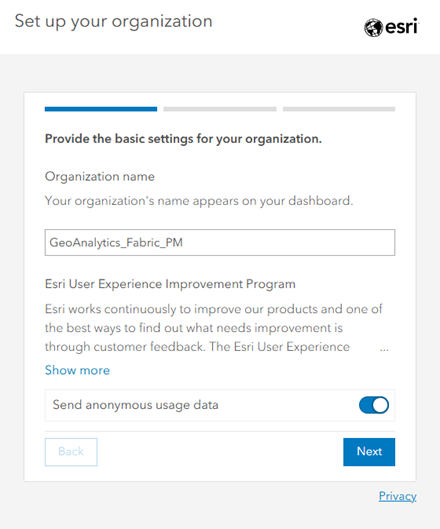
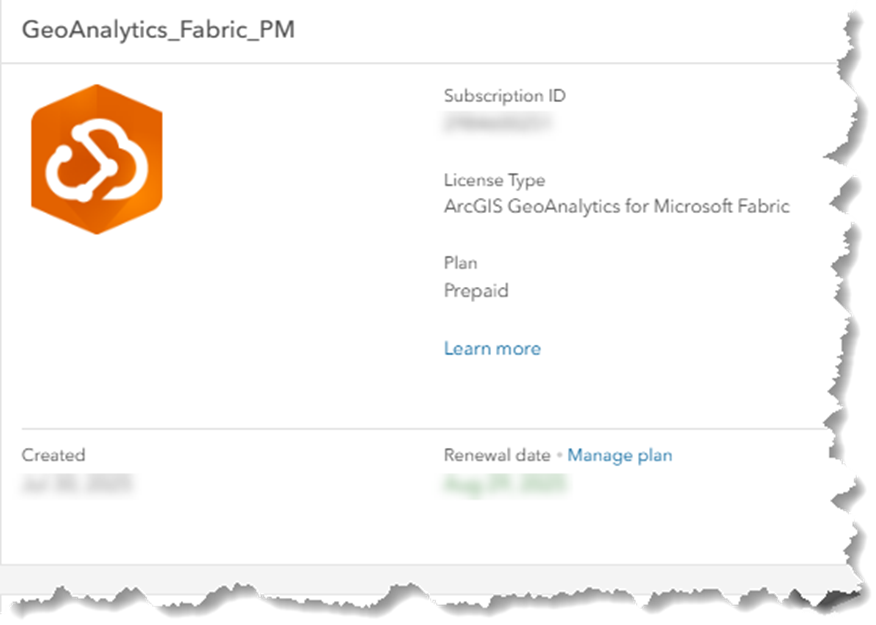
As an example, the organization shown below in the GeoAnalytics for Fabric dashboard is named “GeoAnalytics_Fabric_PM”
- Provide account details and accept the master agreement and privacy policy terms. This is where you can set the name and email for the administrator of your account.
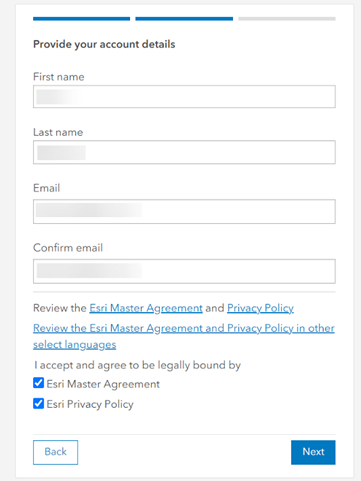
Account name. At this point in time, the name associated with the account cannot easily be updated, so you may wish to select an organization-specific, but generic, name, e.g. “MyOrg GeoAnalytics Admin.”
Account email. When your GeoAnalytics for Fabric account is set up, it is tied to a single email address for the organizational administrator. You cannot change this via the GeoAnalytics for Fabric dashboard user interface.
To future-proof, we recommend using an email alias internal to your organization (e.g., geoanalytics_admin@yourOrganization.com) instead of a single user’s personal email address. By doing this, the alias can be managed and re-directed internally by your organization if the GeoAnalytics for Fabric administrator departs, changes roles and is no longer administering your GeoAnalytics for Fabric license, or you no longer have access to the emails sent to their individual user email.
- Set up your account user name. If you have an ArcGIS Online account, please note that the GeoAnalytics for Fabric user name is not the same as your ArcGIS Online user name. It is a separate user and separate account type.
A GeoAnalytics for Fabric subscription will have one user name associated with it.
User names are unique and they cannot be changed. We recommend selecting a user name that is distinct to your organization but not to the person administering the account. For example, sbattersby_geo would not be recommended as it references a specific individual “sbattersby,” while “geoanalytics_myOrgName” might be a better choice to indicate that this user name is specific to the GeoAnalytics for Fabric product.
Once you have created your account you are ready to authenticate and work with GeoAnalytics for Fabric. In general, we recommend generating API keys for authentication instead of using this account administrative credential directly for authentication. More details on setting up and working with the API keys can be found in the product documentation for information on methods for authorization using your credential or API keys created for your account.
Conclusion
We hope that this was helpful to have a detailed walkthrough of the setup process! We look forward to hearing how you’re using GeoAnalytics for Fabric to elevate your data analytics workflows.
