I'm using setbackPerEdge to perform setback operations using a array. I use the edge indices from comp(fe){all: comp.index} to perform different operations dependent on the index I get back, which requires the indices of edges to not change, or change in a predictable manner.
When I use the setbackPerEdge after having used a shapeO (or setback operation to get the same result) the new leaf shape has it's edge indices permutated compared to the origin: here is an example where I have a rectangular shape as an initial shape(left) and as we go from left to right we first create an ) shape, then we apply setbackPerEdge a certain number of times as seen in the image bellow:

at each point I'm translating the shape and visualizing the edge indices of the new shape. As can be seen, the first application of shapeO maintains the edge index order - while adding the new ones at the centre. as soon as we start applying setBackPerEdge to this new shape the edge indices start to shift 0->1, 1->2, and so on.
If we do the same operations on a slightly different initial shape the indices shift in a different way as shown below, where 0->2 and then 2->0 in an alternating way
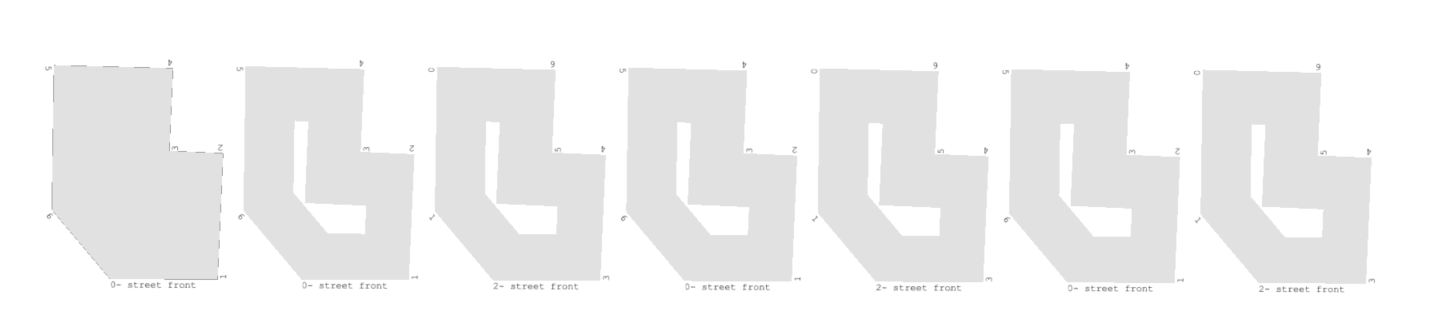
how do I maintain the indices consistant or keep record of how they change in a predictable manner so I can use them reliably?
The code to reproduce the example is shown bellow:
---
version "2022.1"
import Text:"/ESRI.lib/rules/General/Text.cga"

attr setbackArray = [0,0,2,1] #organized as [front, right, back, left]
attr originalNumEdges = size(edgeLabels)
edgeLabels = comp(fe) { street.front : 0 | street.right: 1 | street.left: 3 | street.back:2 } # to identify index used to query setbackArray for each edge
_edges = size(edgeLabels)


attr floorPlate = 12
@StartRule
plot-->
viewIndex(_edges, edgeLabels)
endShape
setback(
comp(fe){
street.front: floorPlate + setbackArray[0] |
street.right: floorPlate + setbackArray[1] |
street.back: floorPlate + setbackArray[2] |
street.left: floorPlate + setbackArray[3]
}
)
{
all= _footprint(_edges, edgeLabels) |
remainder: NIL
}

_footprint(numEdges, currentEdgeLabels)-->
print(numEdges)
t(50,0,0)
viewIndex(_edges, edgeLabels)
endShape
setback1(_edges, edgeLabels)

setback1(numEdges, currentEdgeLabels)-->
t(50,0,0)
print(_edges)
setbackPerEdge(setbackArray[currentEdgeLabels[comp.index]]){
all= NIL
|remainder:
viewIndex(_edges, edgeLabels)
endShape
setback2(0)
}

setback2(i)-->
case i>3:
NIL
else:
t(50,0,0)
setbackPerEdge( 0 ){
all= NIL
|remainder:
viewIndex(_edges, edgeLabels)
endShape
setback2(i+1)
}


viewIndex(numEdges, currentEdgeLabels)-->
comp(fe)
{
all:
[
case comp.index<originalNumEdges:
case currentEdgeLabels[comp.index] == 0:
# t(5, 0,0)
Text.Letters(comp.index + "- street front",1.5)
else:
# t(5, 0, 0)
Text.Letters("" + comp.index,1.5)
else:
NIL
]
}

endShape -->
color(0.8,0.8,0.8)
endShape.