Hi everyone,
I am working with an Esri Utility Network for a gas distribution system and I have a specific question regarding the best practice for handling gas measurement points (PM) - (or interconnection or interception points) - and valves as subnetwork controllers.
In our current system (geometric network), districts are defined by these three objects:
Here is a simplified illustration of the scenario:
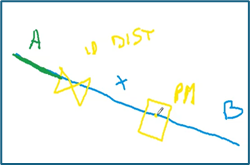
The green line represents District A .
The blue line represents District B
The valve (depicted as a butterfly symbol) is located on the boundary between District A and District B.
The measurement point (PM) is very close to the valve (about 1 meter apart) and belong to District B.
If we configure both the valve and the PM as subnetwork controllers, this will causes issues with the subnetwork validation because the middle pipe (X) that in real is form district B would be defined ad a new mini district.
My doubts and questions are:
Is it recommended to use only valves as subnetwork controllers and treat measurement points (PM) as regular assets logically connected to valves? In which fcl/asset group/asset type is better to put the PM them? which rules we can use (junction-edge or put the measurement point away from the pipeline)?
Alternatively, is there a best practice to model measurement points and valves both as subnetwork controllers when they are so close and belong to the same district?
How have other utility network implementations handled this kind of situation?
Are there specific subnetwork rules or configurations that can prevent validation errors in this case?
Thanks in advance for any advice or examples!
Astrid

Solved! Go to Solution.
@CoronaGis Thanks for posting your use case with details and drawing. I encourage organizations to conceive the best way to model the network, rather than duplicate what a legacy system used to do. Utility Network has much broader modelling capabilities with greater possibilities.
Here are my comments:
Utility companies often have unique business requirements that drive the modelling decisions. Hoping others in the community will share their implementation advice.
@CoronaGis Thanks for posting your use case with details and drawing. I encourage organizations to conceive the best way to model the network, rather than duplicate what a legacy system used to do. Utility Network has much broader modelling capabilities with greater possibilities.
Here are my comments:
Utility companies often have unique business requirements that drive the modelling decisions. Hoping others in the community will share their implementation advice.
It depends on the kind of valve between the two districts and what tier the subnetworks belong to. I'll call out @TomDeWitte for the final design intention of the model since it doesn't contain any definition of a district metering area. At the end of the day, it is your model, and you should configure it to meet your needs.
If we interpret your question through the way the model comes configured, I have to assume that the district is either a system, pressure zone, or isolation zone. You can look at the data model to see what devices are allowed to control subnetworks to infer how the model was designed to be used:
System - If these districts represent different systems and the PM is actually a meter, then this could be represented as a system subnetwork where the PM is a Custody Transfer Meter.
Pressure Zone - If the valve regulates pressure, this could be represented as a pressure subnetwork where the valve is a regular and the subnetwork controller. The PM would be a Pressure Monitoring Device.
Isolation Zone - If the valve is a Controllable Valve between two arbitrary areas of your network that you want to be isolation zones (it seems unlikely, but I'll mention it here). The
If it's some kind of metering district, then we'd be talking outside of the current configuration, and I'd want to defer to Tom before I exercise too much creativity.
When I looked at your diagram, I interpreted it to be at least 2 OVERLAPPING subnetworks. The Gas Measurement Meter (PM), I would guess to be what we call a custody transfer meter, which is one of the types of device our gas and pipeline industry model uses as a subnetwork controller to distinguish between two system subnetworks. The valve at the edge of your districts could be a pressure regulating valve, which our gas and pipeline industry model uses as a subnetwork controller to distinguish between two pressure subnetworks, or the valve could be an controllable valve used for emergencies, in which case we use that type of valve as a subnetwork controller to distinguish between two isolation zones. The pipe between the two devices can belong to more than one type of subnetwork. That pipe will participate in a system subnetwork, a pressure subnetwork and a isolation subnetwork.
Tom