My name is Michaelmary Chukwu, and I recently earned a master’s degree in Geography from the University of Arkansas. This fall, I will begin my Ph.D. in Geographical Sciences at the University of Maryland, College Park. During my master’s studies, I developed a strong interest in the rapidly evolving fields of GeoAI, Urban Informatics, and Computational Social Science, thanks in large part to the guidance of my advisor, Dr. Xiao Huang (now at Emory University). As the discipline of geography continues to expand—intersecting with computer science, data analytics, mathematics, and other domains—it is creating exciting new opportunities for young professionals. This article aims to introduce one of the most promising frontiers in this transformation: GeoAI, and how you can begin to leverage it.
There's been a growing interest—and quite a bit of buzz—around GeoAI (Geospatial Artificial Intelligence)—especially among those working in GIScience, geography, urban planning, and data science. While the term might sound technical, its core idea is simple but powerful: GeoAI combines the spatial thinking of geography with the computational power of artificial intelligence. It allows machines to better interpret location-based data and make predictions, detect patterns, or generate insights that are specifically grounded in geography.
As its name suggests, GeoAI sits at the intersection of geographic knowledge and machine learning (ML) techniques. It enhances traditional geospatial analysis by introducing AI capabilities like spatial clustering, predictive modeling, and spatiotemporal forecasting—opening up new possibilities for solving complex problems in environmental monitoring, urban mobility, disaster response, and public health.
Our recent paper, Mapping the Landscape of GeoAI in Quantitative Geography, published in the International Journal of Applied Earth Observations and Geoinformation, represents one of the first efforts to chart the breadth of this emerging field. In that work, we identified 14 subdomains of human geography—from health geography to economic activity—already benefiting from GeoAI. We also outlined some of the ongoing challenges facing researchers and professionals seeking to adopt these tools, such as data quality, computational demands, and interpretability of AI models.
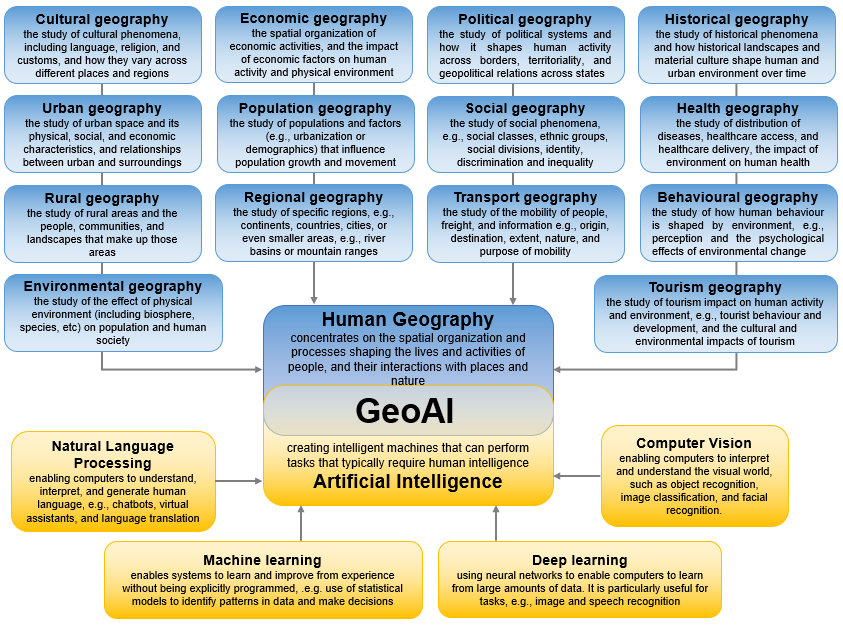
Figure 1: Applications of GeoAI in Human Geography.
Image credit: Wang et al (2024)
What really is GeoAI?
One of the most common questions I hear—especially from students or early-career professionals—is: “Where do I even begin with GeoAI?” It’s a fair question. GeoAI is a fast-moving field. In just the past two years, it has surged forward with remarkable momentum, driven in large part by academic researchers producing a growing number of publications. Some focus on theoretical models, while others are building open-source Python tools for use cases like soil classification, solar panel detection, and building footprint extraction from satellite imagery.
Industry has also taken notice. For example, Esri has incorporated a suite of GeoAI tools into ArcGIS Pro, including Imagery AI, Text Analysis, Time Series AI, and Feature and Tabular Analysis. These tools leverage automated machine learning (AutoML), deep learning (AutoDL), and pretrained models to simplify complex workflows. So, if you're already familiar with ArcGIS Pro, one great starting point is to explore the Imagery AI toolbox—particularly the “Extract Features Using AI Models” tool.
Artificial intelligence meets geography: GeoAI is born
But what sparked the emergence of GeoAI in the first place? The short answer: spatial big data. In our increasingly sensor-rich world, geographic data is being produced at unprecedented scales—from GPS signals, satellites, social media, and IoT devices. Traditional methods alone can’t keep up with this explosion of data. That’s where GeoAI comes in. By integrating AI with high-performance computing (HPC), we can extract meaningful patterns from large, messy, and dynamic spatial datasets.
Interestingly, the roots of this idea aren’t new. As Liu and Biljecki (2022) pointed out, one of the earliest books to explore AI in geography was Artificial Intelligence in Geography by Openshaw and Openshaw (1997). That publication laid the groundwork for merging computational thinking with spatial reasoning—what we now call GeoAI. Today, we’re witnessing that vision come to life.
Takeaway for young professionals
Young professionals pursuing GIS careers have a unique opportunity to get involved and start leveraging these tools now. One exciting entry point is the Segment Anything Model (SAM), released by Meta in April 2023. SAM enables zero-shot generalization, which means it can classify parts or whole of an image without needing retraining. Users can simply draw a bounding box over a feature of interest—like a tree, building, or road—and the model will generate an accurate object mask.
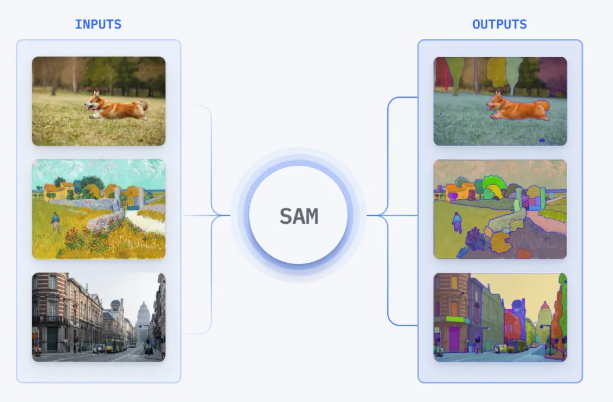
Figure 2: SAM: left images are source input while right images are output masks from SAM.
Image credit: v7labs.com
The architecture behind SAM is elegantly simple illustratively; but convoluted in actual sense: an image is passed through an encoder, converted to an embedding, processed through a prompt encoder, and then passed to a mask decoder to generate the final output. Though originally designed for general image segmentation tasks, SAM has already been adapted to spatial data—including high-resolution remote sensing imagery. Researchers are now using it to map urban vegetation, infrastructure, and environmental features across different landscapes. All of this is part of the broader promise of GeoAI—to transform how we observe, interpret, and interact with the spatial world around us. Whether you're working in city planning, environmental management, transportation, or disaster response, GeoAI offers tools that can make your work smarter and more impactful.
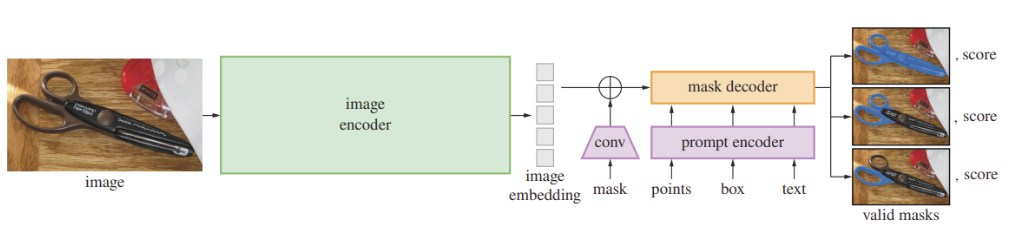
Figure 3: Architecture of SAM.
Image credit: Qiusheng Wu
Concluding remark
In conclusion, this article is a brief introduction to what GeoAI is, why it matters, and how young professionals can begin to explore it. The field is wide open, and the tools—like SAM, Imagery AI in ArcGIS, and various Python libraries—are more accessible than ever. By getting involved now, you're not only building skills that are in high demand but also helping shape how AI and geography come together to solve real-world problems. So go ahead—open ArcGIS Pro, explore the GeoAI toolbox, or try running a SAM model on satellite imagery. The future of spatial analysis is unfolding, and GeoAI is at the center of it.