Welcome to my second blog post! In my first post, Sparking a Passion: How GIS and Remote Sensing Shaped My Career Path, I introduced my academic background and how I was guided to geospatial analysis. I also mentioned that my next journey would be backpacking through Latin America. Well, plans changed—I ended up pivoting directions and headed to Asia instead! In this blog I will talk about my adventures in Asia, an unexpected way that GIS is saving lives in Laos, and how we can help grow the geospatial field to help solve a wider range of global challenges.
Solo Traveling Asia
My trip included visiting three countries: Thailand, Laos, and Vietnam.! Highlights from each country included earning my PADI Open Water Scuba Diving Certification in Thailand, volunteering with Big Brother Mouse to help kids improve their English in Laos, and riding the Ha Giang Loop in Vietnam. This journey strengthened my communication, analytical, and management skills. Traveling pushed me to continually learn, adapt, and overcome challenges—skills I translate into the professional setting.
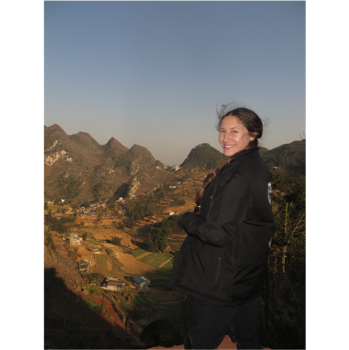
Stop along the Ha Giang Loop!
Unexpected GIS Applications in Laos
While traveling, I enjoy learning about the history of the countries I visit. During my time in Laos, I spent an afternoon at the UXO Visiting Center in Luang Prabang. This museum is dedicated to educating travelers about the 2 million tons of bombs dropped on Laos during the Vietnam War and the unexploded ordnance (UXO) that still litters the land from bombs that failed to detonate. These UXOs have caused numerous casualties years after the end of the war.
It was an emotional visit, but an impactful learning experience. GIS applications have been used to support planned detonation efforts and inform both Lao citizens and visitors about UXO risks. Maps have been created to show which areas were bombed the heaviest, inform farmers where land is safe to cultivate, and teach kids how to walk safely to school. Even with the efforts of the Lao National Unexploded Ordnance Programme (UXO LAO) and their international partners, there is still much work to be done to make the land safe and usable again.
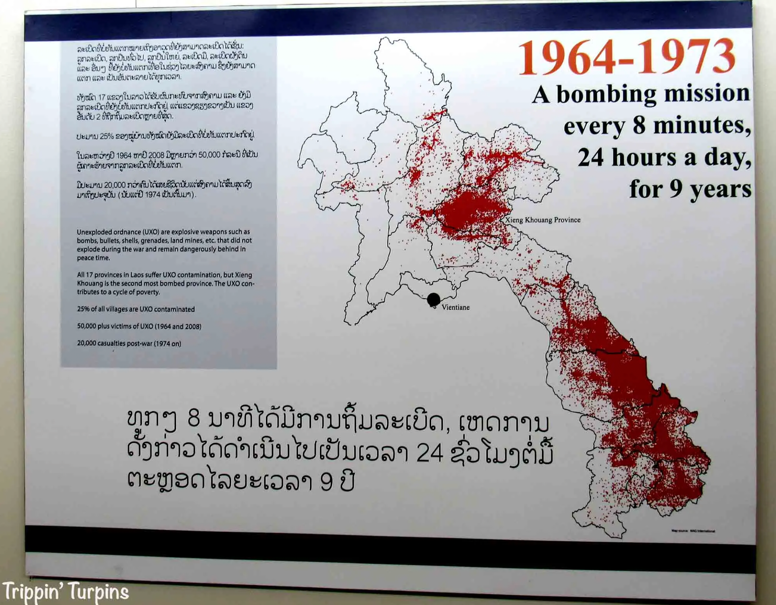
Map of the bombing missions in Laos.
Conversations Abroad
While solo traveling (counterintuitive to what you might think), you end up meeting a lot of people! I met locals and fellow travelers from around the world. Among travelers, the three most common introductory questions are: “What’s your name?”, “Where are you from?”, and “What do you do?”
Traveling gives you the chance to meet people from all sorts of professions that you don’t typically encounter on a day-to-day basis, like students, teachers, flight attendants, architects, entrepreneurs, professional athletes, and more. However, whenever I answered, “I work in geospatial analysis,” I was often met with puzzled looks and the question, “What is that?” I would respond with a simple explanation: “Geospatial analysis is using satellite images and data to help solve problems.” This often sparked curiosity and was usually followed by the response, “I’ve never heard of that before!”
Room for Growth
It seemed to be a reoccurring theme that people outside of the geospatial field had never heard about it, thus not knowing that it can be used as a tool in their line of work! The geospatial field is growing and expanding globally, but there are still a lot of areas that geospatial analysis is underutilized. Just as I didn’t know about the challenge of UXO’s in Laos, there are a lot of other issues around the world that can benefit from including geospatial analysis in their problem solving. It’s important that we share our stories not only with other scientists, but also with the general public to highlight the power of GIS and remote sensing. You don’t have to travel the world to make a lasting impact. Growth starts small, and can start with you.
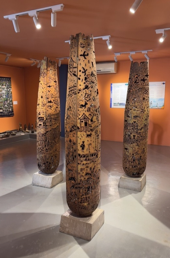
Bomb shells transformed into storytelling art.
With my gap year coming to an end, I am actively pursuing geospatial career opportunities that combine my technical background, leadership experience, and passion for protecting the environment. I’ll be attending the YPN San Antonio Chapter Meetup on September 25th—I hope to meet some of you there!
Call to Action for GIS Students and Professionals
To conclude, I challenge you, readers—share your work with people outside of the geospatial field! Let others know how geospatial data can be a tool to help solve problems in their field. By opening more eyes to the power of GIS, we can expand its impact and address a broader range of global challenges!
Thank you to everyone who took the time to read my post! Feel free to comment any questions or thoughts that you have. You can connect with me on LinkedIn or email me at chassetyraines@outlook.com.
 Exploring life under the sea in Thailand!