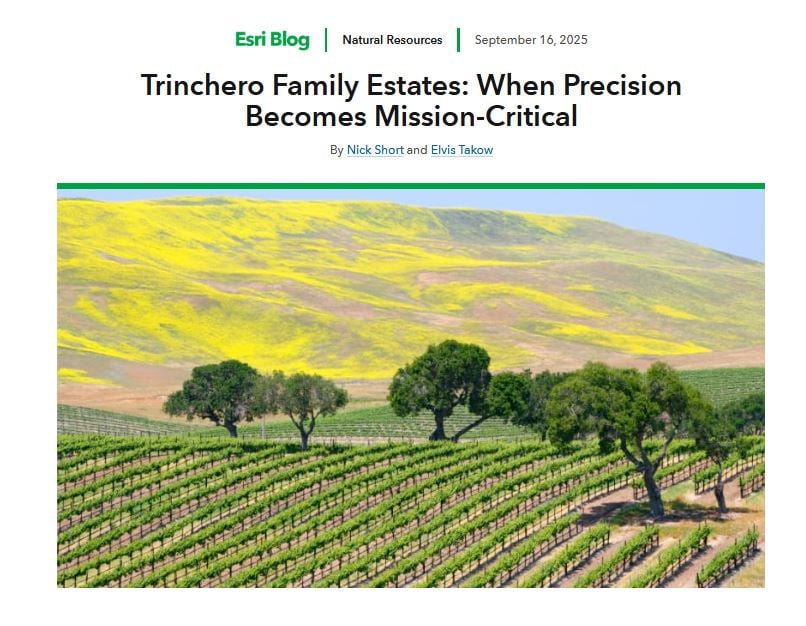
Terroir—the idea that wine reflects the unique soil, climate, and landscape where grapes grow—is no longer left to guesswork. At Trinchero Family Estates, GIS technology is transforming how one of America's leading vineyards measures, monitors, and manages sustainable agriculture across 9,000 acres.
Nick S. and Elvis Takow, PhD have witnessed firsthand how agriculture is evolving from intuition-based farming to data-driven precision. The story emerging at Trinchero represents a fundamental shift they've observed across the industry: spatial intelligence becoming the foundation for sustainable agriculture decisions that balance environmental stewardship with operational efficiency.
Douglas Wood exemplifies this evolution. When he joined Trinchero Family Estates—the fourth-largest winery in the United States—he inherited paper maps and mismatched spreadsheets covering vineyards spanning ten California counties. Today, Wood has built a geospatial infrastructure that treats every vine with boutique-level precision, despite managing a scale that produces 18 million cases of wine annually. His GIS system captures the micro-differences that define the character of each grape type, and monitor with precision the optimal harvest timing for the best quality wine. From yield projections that coordinate 100+ harvest trucks to scouting apps that track vine health in real-time, Wood has embedded spatial data into every farming decision.
Read this story about precision agriculture at its finest:
Trinchero Family Estates: When Precision Becomes Mission-Critical
\